Showing posts with label Francis Bacon. Show all posts

Friday, 19 August 2011

British Masters

Last year I was fortunate enough to attend Lucian Freud’s last major exhibition at the Pompidou in Paris. There’s a blog about it in the depths of my timeline (here).
So it was with some sadness that I heard he died. He was our greatest living artist in my honest opinion.
The enthusiastic art historian Dr James Fox recently hosted a programme on the BBC called British Masters, he spoke with authority but not any pomposity about the period of British Art History 1910 – 1975. Assuming we don’t rip each other to shreds by then, he believes that in centuries to come, this will be seen as a defining period in Art, on a par with the renaissance, so his passionate delivery was a breath of fresh air.
Freud was old school, he knew, fraternised or fell out with most of his artistic peer group as well as his family. Sixty years ago he was getting drunk with Francis Bacon in some Soho dive. Within the last few years he was dancing with Kate Moss in some west London club. Even shortly before his death he was, on most nights, dining with one of his daughters in the Wolesley. As an aside the waiters laid his regular table in his honour with a black tablecloth and single candle when they heard he died – however some diners felt he had a scowl that could curdle milk should you annoy him. Next day, Dale Winton had his table, it is alleged…
Although intensely private, turning down interviews, writing shitty letters (which became so popular he stopped sending them as journalists would frame them) he led an active social life. On his own terms. It seems duty was not high on his agenda which meant he didn’t attend his mothers funeral, but that didn’t stop him being generous to those he loved. And it sounds like he loved a lot, with thirteen official children, and probably up to forty in total.
He worked almost to his dying day, a realist painter, his art recognisable from the flesh. He mostly painted from, and in, his studio. Apart from some very early works, he rarely painted an outside scene. Which is why this particular painting interested me. It’s from his garden, I can’t find the reference, so I may have imagined it, but I believe this is where he buried one of his dogs. It seems intensely sad to me. A pet’s love is unconditional, the tragic (and extremely simple) romantic in me thinks this some expression of love for a creature that has simple needs, he couldn’t handle or be bothered with the complexity of human relationships perhaps, breaking his habit of only painting indoors for old Fido or whatever his pooches name was. This is a photo of the work, by David Dawson his long time assistant.
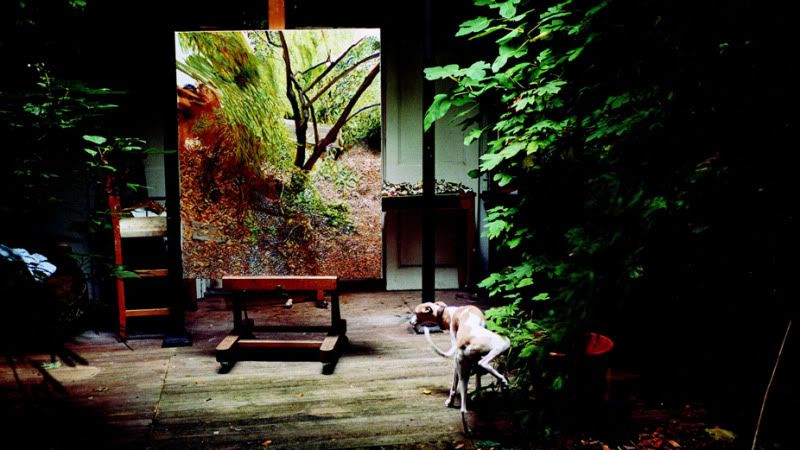
It’s called “Painters Garden with Eli, 2006” – Eli being his last dog.
Tate Britain is currently exhibiting a few items from their Freud collection. This one particularly captivated me, it is of Harry Redknapp Francis Bacon, an unfinished piece. But getting right up close to it, you can see the incredible brushwork, Freud truly was a master.
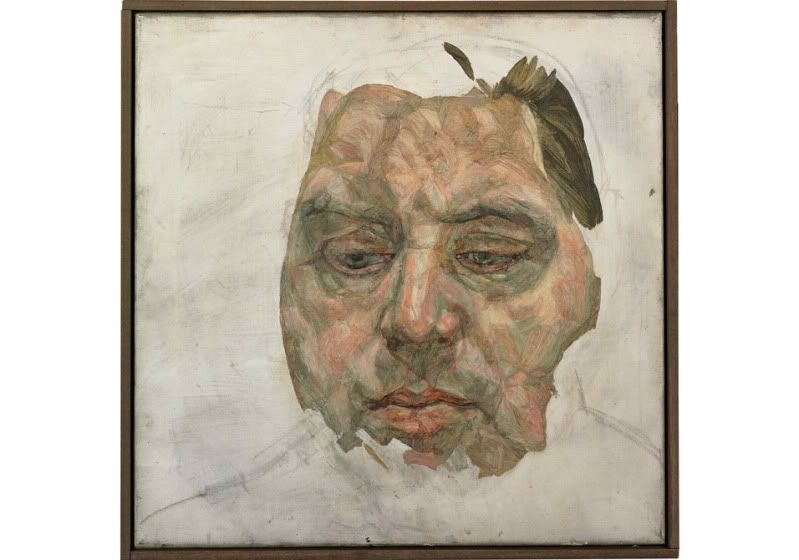
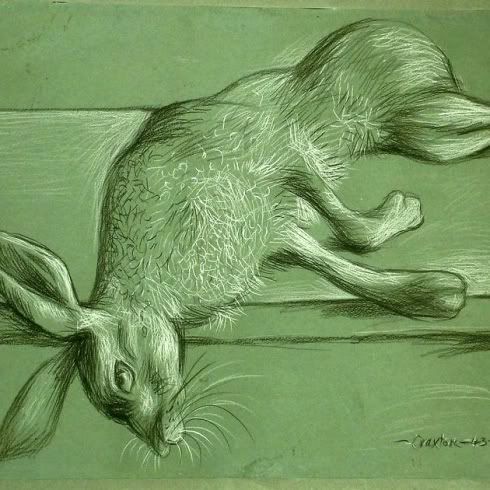
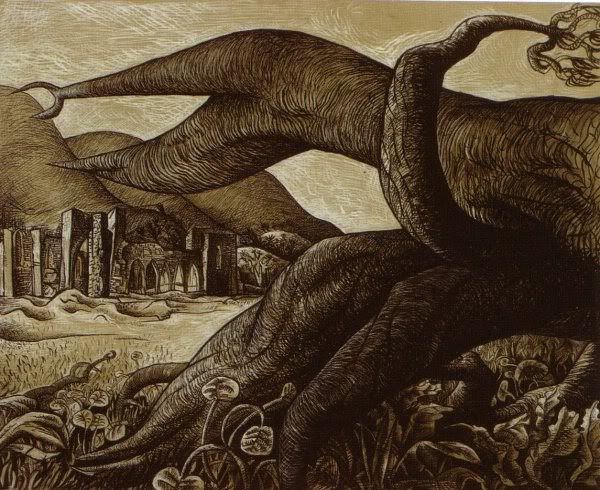
As well as this Freud work, there is a small gallery dedicated to an artist I’d never heard of before John Craxton who died in 2009. His early work was very fluid and technically brilliant, his later work being more free. “Neo Romantic” was the term the Tate used, citing William Blake as an influence.
I really liked his work, especially the early stuff. Such as :
Hare in Larder 1943
Llanthony Abbey 1942
Now Craxton, he roomed with Freud when they were studying. Craxton showed the greater promise as a youth, but Freud kicked on, whearas Craxton, although brilliant, lived the good life in Crete where he settled. Freud came to visit him and they would, as was the tradition in their friendship, exchange each others sketches and paintings at the end of the visit.
Now, Freud gambled, a lot. He generated huge debts. So much so that he sold Craxton’s painting to pay off some of these debts, with a “you don’t mind do you?” to Craxton, who was probably rightly slighted.
In later years, when the money wasn’t coming in for Craxton, he himself decided to sell a few Freud’s, they were worth a lot more money then, to raise some cash. After all, his old friend sold some of his paintings didn’t he?
The agent tasked with selling them, took the original works to Lucian Freud to verify their authenticity. Freud was not best pleased. But he verified them all right. On each, he wrote :
“John Craxton is a cunt. Lucian Freud”
RIP Lucian Freud and John Craxton.

Sunday, 18 April 2010

Francis Bacon - In Camera @ Compton Verney


Compton Verney... where? That's what I thought when I saw this exhibition advertised in the Independent. It's a pleasant country house in the middle of Warwickshire is where. (I imagined Royston Vasey...)

Francis Bacon is one of my favourite artists, and as the journey to get there wouldn't be too unpleasant on a lovely sunny day, I drove up to Compton Verney to have a look. I went to the Tate exhibition a couple of years ago, which was a brilliant and fairly representative collection of his life's work and although this exhibition was small and therefore there wouldn't be much "new" work on show it did provide some insight into how Bacon worked. How he was influenced and inspired by photography, and also touched on his influences from other artists :Michelangelo for instance, of which there were some torn out pages exhibited from a book owned by Bacon showing Michelangelo's anatomical sketches, splattered with the paint of Bacon's brush. And of course there was Velazquez (although there are no popes in this exhibition, screaming or otherwise)

(Page from a Muybridge book owned by Bacon - messy pup, got it smudged)

When Bacon died, a lot of his resources came to light within his studio (amazingly this was archeologically and painstakingly moved in exacting and brilliant detail from West London to the Hugh Lane Gallery in Dublin), photography from the late 1800's by Eadweard Muybridge for instance, showing the althletic motion of people and animals in stop motion frames. On top of this he had more contemporary resources, cuttings from sports magazines, bloodied boxers, footballers, cricketers stretching for a shot as well as photography from his friends, most notably John Deakin.

Bacon's style, the contorted and tortured figures, writhing, seething into one form, sometimes melting away into nothing, other times reduced to pulped meat really make me feel something. There's violence and sexual energy in a lot of his work, which reflected his upbringing and journey into adult relationships. And an intense sadness. It's hard not to feel something.
It was interesting to see what he did with photos, he'd crush them, rip them, tear them up and then repair them for instance, thus this patchwork repaired photo was what he sometimes used to spark the creative energy to create the painting it ultimately became. This is one of the works on show (I don't believe this was exhibited in the Tate) of his model Isobel Rawsthorne which was based not on a sitting but on three photographs provided by Deakin. I would have taken a picture of the photographs it was based on which was exhibited side by side with the painting, but the beady eyed old security lady with the walking stick would have told me off as there was a strict no photography rule.... and I fancied she was faster than me over 10 yards...


The exhibition also touched on Bacon's inspiration by the moving image. They were showing the "The Battleship Potemkin" a silent soviet propoganda movie where a characters scream inspired Bacon to paint screaming popes (mashed up with Velazquez's popes). Interesting film, especially the way the Tsarist soldiers march down the steps like faceless automatons, lacking compassion, mercilessly butchering the wailing masses (Cossack mo-fo's!) and the use of shadow and light was awesome in the film, especially the way the shadows of the soldiers bayonetts seem to push the crowd in terror down the Odessa steps. Would have been nice to squeeze in a screaming pope painting in the exhibition, as it would have looked cool side by side with the movie still....


I'll be spending the rest of my birthday money on a couple of books now
Francis Bacon: Incunabula by Harrison a lovely hardback book which loosely covers the exhibition and
Francis Bacon: Anatomy of an Enigma, by Peppiatt, a biography of the tragic artist, his life and lovers

To summarise, well worth a visit! Now until 20th June.

Followers