Showing posts with label World War 2. Show all posts

Friday, 30 March 2018

Charmed Lives in Greece at the British Museum

I visited the British Museum with my brother this week, taking the day off on my birthday. A combination of it being the beginning of the Easter school holidays and a rainy day driving tourists and locals alike to pursue indoor leisure activities meant the museum was heaving. The dank smell of wet clothes hung in the air, even in the bright, high ceilinged central space of the Great Court.

A little Oasis of calm however, and the reason for my visit, were the galleries dedicated to a touching friendship of three men which lasted decades. Charmed Lives in Greece centers on the artists Nikos Hadjikyriakos-Ghikas and John Craxton and the writer and adventurer Patrick Leigh-Fermor.

They were very different in many ways, but what they shared was a lust for life, for joy and for keeping an open mind, never ceasing to learn about the world and to learn from the people they came across, be they princes or peasants. There seemed to be no arrogance about them, and both Craxton and Leigh-Fermor added themselves to that long line of those peculiarly revered eccentric English people in Greece, going back to Byron, drawn by the classics but on arrival opening their eyes to so much more. They threw themselves wholeheartedly into the society, assimilating and ingratiating themselves with the locals, learning the language, the songs and customs and becoming universally loved in their adopted country of Greece.

As well as a narrative of their individual journeys in life, it captures their times together in various parts of Greece, be it Hydra, Kardamyli, Chania or Corfu.

This is achieved through paintings, illustrations, photographs, letters, books with hand written dedications and personal items, such as Leigh-Fermor’s typewriter and his photographer wife Joan’s camera whose work is also well represented in this exhibition.

Ghikas’ art looks to come from within, even when painting a landscape, there is something of the inner dream about it. It feels personal, and as this short film states, he was more of an introvert compared to his English friends.
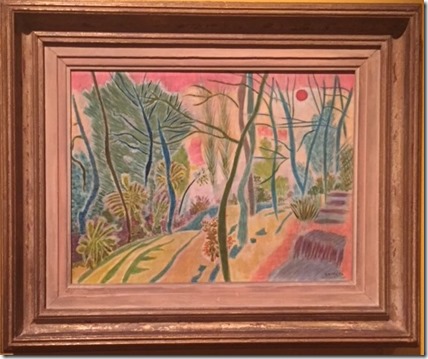
Ghikas

(Ghika, Trees on Poros, 1950)

And although quite similar in terms of their use of geometric forms and nods to cubism, there is an exuberance in Craxton’s work, an energy, sometimes a sexual energy, celebrating the working people of Greece, be they shepherds straining to quell sinewy goats in the mountains, or doleful sailors enjoying a meal and a cigarette in a rowdy taverna. Young men. And cats. Lots of cats, a passion he shared with Joan Leigh-Fermor (Patrick was less enthusiastic about felines). My brother was convinced he’d seen Craxton’s work before, in his Greek school study book from when he was a child. It seemed very apt and also a little subversive that these snapshots of working class life were celebrated in an otherwise cheerless textbook. I hope this is true as it’s a wonderful anecdote that the most memorable aspect of learning Greek was Craxton’s evocative art! (Neither me or my siblings are particularly proficient at Greek, we get by…)
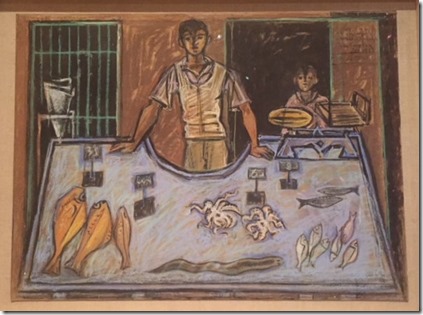
Craxton

(John Craxton, Fish Market, Poros, 1952)

Finally there’s Patrick Leigh-Fermor, the rebellious, heroic charmer who captured a German General along with his Greek resistance friends in Crete in World War 2. I’ve read “A Time of Gifts”, the first of three volumes, charting his walk from Rotterdam to Constantinople aged 18 in the early 1930s. He’s a very engaging writer, very funny and you bound along with him on his journey. Craxton illustrated / designed the covers of all his books. It’s fascinating listening to Leigh-Fermor’s voice, speaking Greek, he speaks it like a local, with poetic narrative, not a bookish classicist, it made me smile.

It’s a wonderfully diverse, touching and balanced exhibition. And it’s free. At the British Museum until the 15th July.

Wednesday, 5 August 2015

Reiko Watanabe, Hiroshima


Tomorrow is the anniversary of the nuclear bomb falling on Hiroshima. It’s often the story of the individual which hits home when contemplating the horrors of war and the associated loss of life. In Reiko Watanabe’s case, it’s her lack of a story, the hole left, the emptiness of a future taken from her, the life she could have led, which really hit home for me. She was only 15 when the bomb dropped, helping with fire prevention work with her fellow students. She might be alive today, a grandmother, or great grandmother. We can only imagine the dreams and ambitions she concocted in her youth. The war raged around her, but she had a future.

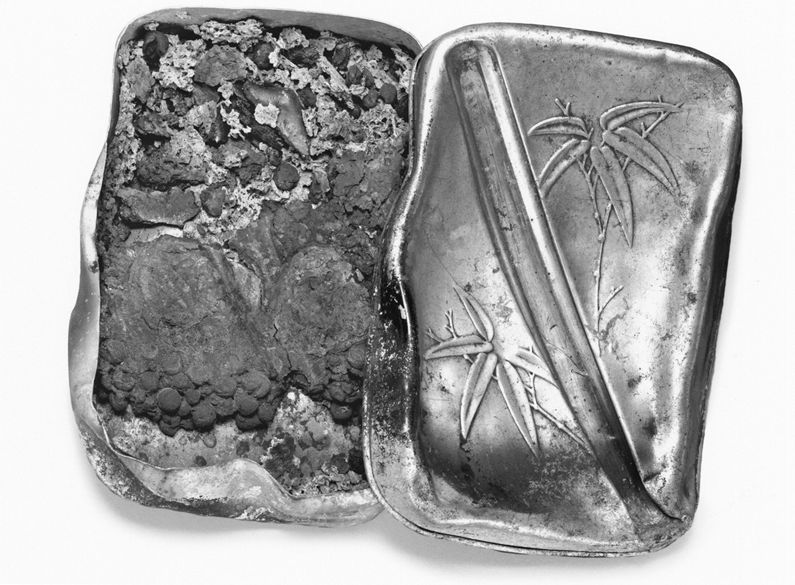
Her body was never found, she was working by a mud wall, and later, her lunch box was discovered, melted, but still distinguishable and full of the rice and peas her mother had prepared for her that morning. It was all carbonised of course, but it was a tiny glimpse to show she was loved. And missed.

The photo below is by Hiromi Tsuchida, it is Reiko’s lunchbox. I first saw this photo in an exhibition at the Tate Modern, Conflict, Time, Photography and I was both chilled to the core at the power of the weapons we’ve made to destroy each other and moved by the humanity of the portrait of this last memento of a young girl’s life.

I wrote these words for her.


Reiko

By the low wall, Reiko diligently performed the fire drill

she briefly saw the white light, In an eerie silence,

Before it blinded her,

moments later the force, hit her,

Vapourised her, leaving the girl,

In the the spring of her youth,

Just a memory to those who loved her,


Her future dreams, caught in the shock wave,

scattered, as single words,

Sewn seeds, in the poisoned fields,

The wall she worked by, it fell,

so that even her shadow,

was lost,


But her lunch box,

Buckled by the heat, survived,

A memento, a tribute to the love,

of her proud mother, who sent her out,

with precious rice and peas,

to help.


Poem © Mel Melis (photograph by Hiromi Tsuchida)

Saturday, 16 June 2012

Stuka


The painted sneering leer, teeth bared,

the siren screams, terror accessories,

Stuka diving, payload emptying,

the silence of light, a moment

before the wall of air hits,

sound boiling inside your head,


Your mother rises, tentative,

unsteady, sapling in the rubble, picks

you up, her seed,

your own hand grey like hers,

as the dust settles, she sees

your eyes open

and her eyes stream, relieved, defiant,

channels in the grime.


©Mel Melis, June 2012

Tuesday, 18 January 2011

The World At War

I was watching one of the history channels the other night as I am oft to do. And the ground breaking and possibly the best TV series on the second world war was being shown. The World At War.
It has the gravitas, the meticulous detail, the big name narrator (Sir Laurence Olivier) and incredible interviews with some of the big players from the era.
26 one hour episodes of captivating, harrowing stuff, without any glamorisation and using incredible original footage. It took four years to film and produce such was the effort put in to bring it to the small screen. Anyone would have thought it was made by the BBC, but it wasn’t, this came from Thames TV, whose claims to fame included such guff as the Benny Hill Show and Love Thy Neighbour…
Watching it as a young kid I was frightened and moved by the chilling opening credits. The music was particularly disconcerting accompanied by the photographs of peoples faces, burning and melting into ashes. It used to terrify me, but I couldn’t avert my eyes. (To be fair, other things used to terrify me too, like my big brothers Pink Floyd album (Meddle) and one of the dinner ladies at my school who had a moustache)
I used to consider and wonder who those people in the photographs were, when did they die, what their names were, where were they from, whether they were happy in life, whether the war interrupted their happiness, whether anyone loved or remembered them. As a kid, it’s almost too big a concept to contemplate the transient nature of mortality, but it stayed with me.

Followers