It was announced this week that the illustrator and author Maurice Sendak had died. He was 83.
It affected me more than I thought it would, here was a man who I only knew through his books, illustrations and marvellously grumpy opinionated interviews, but yet, I felt a deep sense of sadness.
I think it stemmed from his attitude to life, to adults, to the lies all around us. He appeals to the child within us all, before adults indoctrinated us with their fears and lies. This may seem like a strong view, but it’s common for parents to use a lie, thinking this would be less harmful to the ‘fragile’ psyche of a child, than the truth. But Sendak had it all sussed.
“Children are tough, though we tend to think of them as fragile. They have to be tough. Childhood is not easy. We sentimentalize children, but they know what's real and what's not. They understand metaphor and symbol. If children are different from us, they are more spontaneous. Grown-up lives have become overlaid with dross.”
And, in this fantastic, yet ever so melancholy interview with the Guardian last year he said
“I refuse to lie to children, I refuse to cater to the bullshit of innocence."
(n.b – this interviewed also contained the classic “flaccid fuckhead” dismissal of Salman Rushdie after he wrote a poor review about him, something Rushdie accepted with irritated grace on hearing about it).
His books could be both innocent and beautiful, but also angry and challenging. The child protagonists weren’t always good boys and girls. They articulated that peculiar inexpressible rage we all feel as children, where our vocabularies and our social skills are not developed enough to either talk about our feelings or suppress them. For an author such as Sendak to be considered dangerous or frightening, was only a projection of parents anxiety.
“We've educated children to think that spontaneity is inappropriate. Children are willing to expose themselves to experiences. We aren't. Grownups always say they protect their children, but they're really protecting themselves. Besides, you can't protect children. They know everything.”
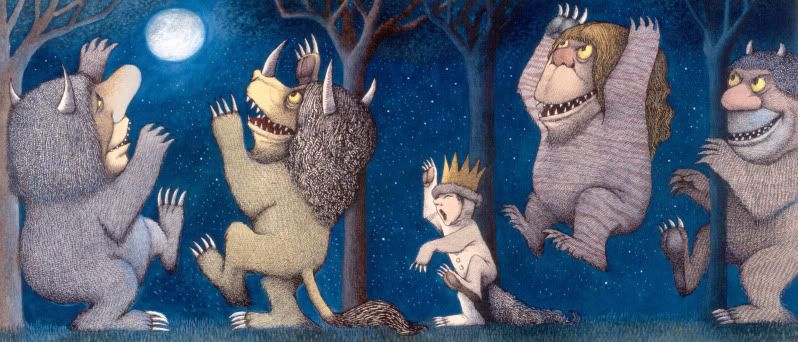
Sendak is best known for Where the Wild Things are of course, where the scolded Max, dressed in his wolf play suit, having been sent to bed with no dinner, embarks on a fantasy adventure to an island where he is King and he can have anarchic violent adventures with his new subjects. When I was little, I remember the big fuss about this book, newspaper headlines about children having nightmares, the goggle eyed, slabbering sharp toothed Wild Things, based on Sendak’s own relatives, invading their dreams. Max’s adventure captured something we all did as children, creating make belief worlds and living in them for a time.
“I believe there is no part of our lives, our adult as well as child life, when we're not fantasizing, but we prefer to relegate fantasy to children, as though it were some tomfoolery only fit for the immature minds of the young. Children do live in fantasy and reality; they move back and forth very easily in a way we no longer remember how to do.”
WTWTA didn’t pander to sentiment or the adults expectation of how a child hero should behave. Max was a naughty little monster, a normal kid, prone to excess and rages, testing his boundaries, preparing himself for life. But he also had that forgiving quality, no matter how angry you got, you always knew who loved you deep down, the anger would pass. It spoke to children at their own level, their own experience and that is why so many people love that book, it has a timeless longevity.
“I remember my own childhood vividly. I knew terrible things. But I knew I mustn't let adults know I knew. It would scare them.”
The Wild Things too, what wonderfully monstrous creations, so vivid and terrifying. Sendak gave them weight and power with his fine pencil cross hatch work.
Other interesting works
I am no expert by any means, having discovered only a small portion of Sendak’s magnificent artistic bibliography. Every time I see something new, I am delighted. The “Little Bear” books, which he illustrated but didn’t write (Else Holmelund Minarik wrote them) are another example of the beauty of his work.
My wife remembered these gentle fairy stories fondly as a child, so we bought some vintage copies a few years ago, so she could own them all again.
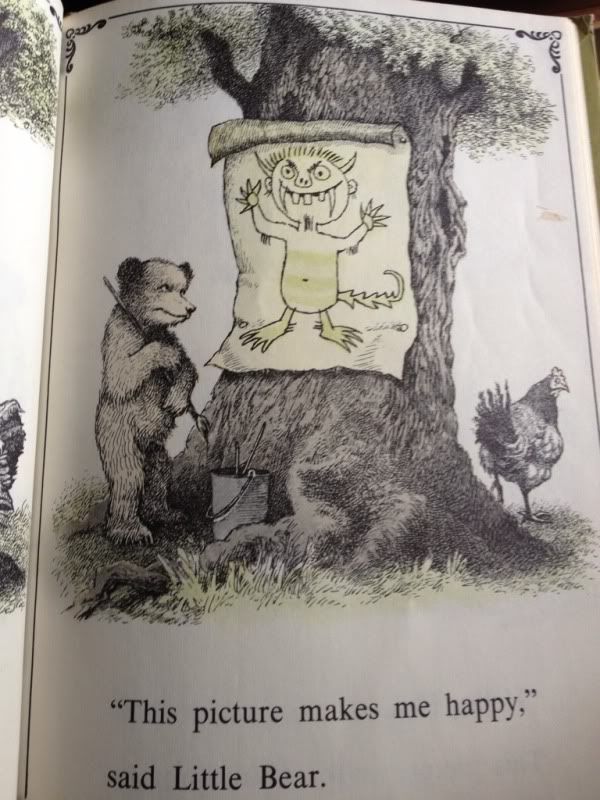
The Little Bear series pre-dates WTWTA by a few years, but “A Kiss for Little Bear” (1968) came after and has a mischievous little “Wild Thing” included within it. (images from Debbie’s first edition)
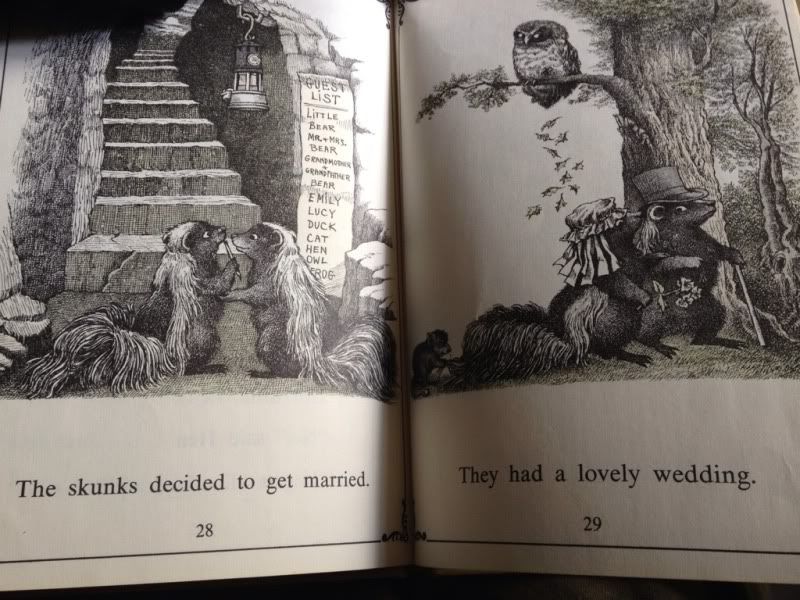
And the skunks got married, good on them!
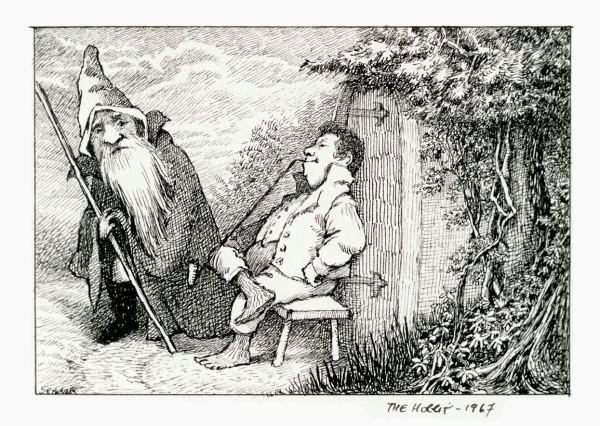
One project I was fascinated to read about was that Sendak was “tried out” for illustrating a 1967 30th anniversary version of The Hobbit, J.R.R Tolkien’s first masterpiece. He prepared two drawings, one of Gandalf and Bilbo and another of Wood Elves dancing. These were whisked off to the then 75 year old Tolkien for review.
This excellent site gives the whole story, but to summarise here, a seemingly unimpressed Tolkien dismissed the two images. Hasty efforts were made to get the two men to meet and agree to work together on what would have undoubtedly been a monumental success, but sadly Sendak (only aged 39 at the time) has a heart attack, spending several weeks recuperating. It happened on the day before they were due to meet, so the project never got off the ground.
A hint at what could have been. Gandalf and Bilbo. Unfortunately the Wood Elves drawing is seemingly lost.
Angry Parents
It’s quite fun to go on Amazon and read some of the reviews of his most “challenging” books. I say “challenging” but then this is a matter of opinion. Most children love to devour scary stuff. A parents fear projected onto a child will cause the child to feel fear. So it saddens me to read some of the comments. There’s no murder, or blood or viciousness. These are great adventure stories with happy endings, children are flawed, but heroic. And fair play to Sendak, he was utterly unforgiving and belligerent about it, as well as many other things!
“Certainly we want to protect our children from new and painful experiences that are beyond their emotional comprehension and that intensify anxiety; and to a point we can prevent premature exposure to such experiences. That is obvious. But what is just as obvious — and what is too often overlooked — is the fact that from their earliest years children live on familiar terms with disrupting emotions, fear and anxiety are an intrinsic part of their everyday lives, they continually cope with frustrations as best they can. And it is through fantasy that children achieve catharsis. It is the best means they have for taming Wild Things.”
A few years ago, I got Debbie a present of Sendak’s interactive pop up book “Mommy?” about a lost child walking through a scary house. He’s lost his mum, he’s on his own, but he isn’t frightened, far from it. Although he’s keen to find her again, he is utterly unphased by the succession of monsters which try to scare him. In fact, they get scared themselves at his pluck. What a fun book! And of course he finds his mum… so what’s the problem?
I’ve taken a photo from our copy of the book.
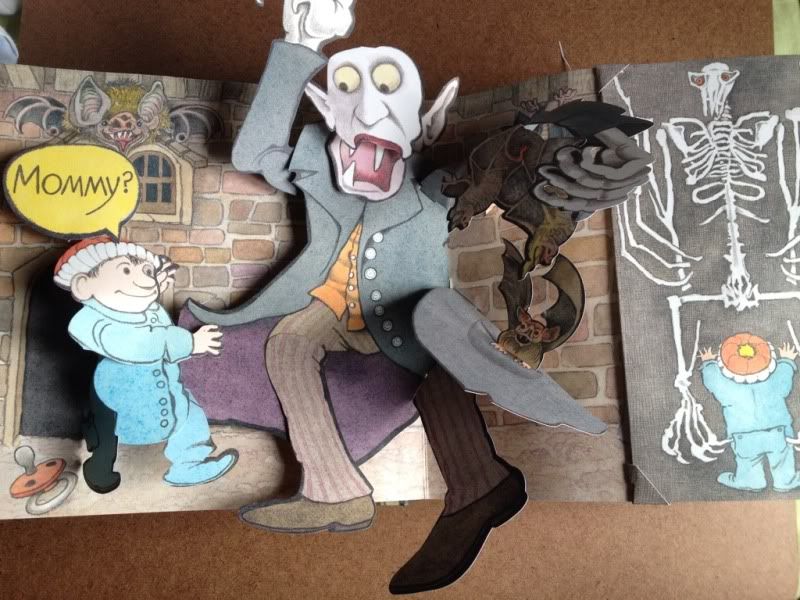
But some of the one star amazon reviews state their children had nightmares and terrors, dismissing his work as awful and frightening. Not fair.
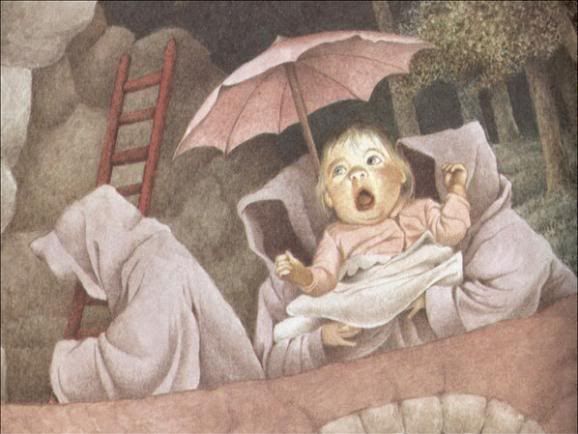
Another book I can’t wait to read is “Outside Over There”, I’m putting it on my wishlist, it’s about a girl whose little sister is kidnapped by goblins, so she sets out on a trek to rescue her. Again, quite adult themes, but this sort of adventure and escape is what children love to read.
In searching for suitable images, I came across this great link/article, from which I’ve lifted the image (credited to the publishers Harper Collins). Looking at the pictures of the faceless hooded goblins though, whoa! It is quite scary, but I’d have loved this kind of stuff as a kid!
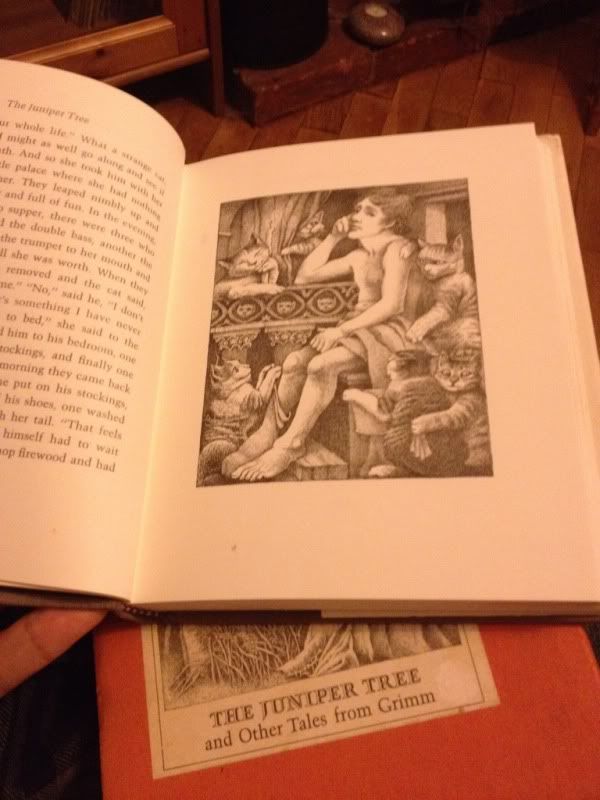
Fairy Tales are another area where Sendak has delivered a phenomenal quality of output. Take the Brothers Grimm translation and compilation “The Juniper Tree”. I wrote about this book on my Haiku blog in January. Where I revisit similar themes.
“Fairy stories are violent and frightening, full of foul acts, murders and dubious cruel characters, but with a clear lesson running through them and where normal people can be heroes. Children love this stuff, we shouldn’t patronise them by making decisions on their behalf as to what is disturbing or scary.” – I haven’t italicised the quote as I’m quoting myself, not Sendak :)
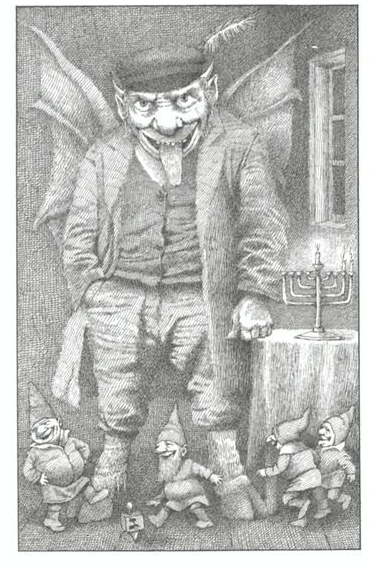
Similarly, he illustrated a book of eastern European Jewish folktales, called “Zlateh the goat”. I don’t own this, but just look at this example of the art! (image from harper collins)
Maurice Sendak didn’t come out as gay until his long term partner died a few years ago. In later life I’m guessing it couldn’t have been much of a big deal for him, but in his younger days, he wanted to keep it from his family. They were old fashioned in their attitude, they wouldn’t have been able to deal with it. That feels so sad.
“I’m gay. I just didn’t think it was anybody’s business. All I wanted was to be straight so my parents could be happy. They never, never, never knew.”
Other than the company of his beloved Alsatian Hermann (after Melville, Sendak chewed the ear off an interviewer who asked who he was named after… “Who’d you think? Goering?”) he was on his own with his memories, revisiting his literary loves. And William Blake. He wanted to die like Blake, who reportedly shot out of bed and started singing hymns seconds before his demise. Sendak’s sharp wit came through with this quote.
"A happy death..it can be done.. If you're William Blake and totally crazy.”
Going back to that Guardian interview from last year, he seemed a lonely old man. But he was ready, he was prepared to die, albeit with some regret.
And as a final quote (not from the guardian), one which seems the most poignant.
“I have nothing now but praise for my life. I’m not unhappy. I cry a lot because I miss people. They die and I can’t stop them. They leave me and I love them more.... What I dread is the isolation.... There are so many beautiful things in the world which I will have to leave when I die, but I’m ready, I’m ready, I’m ready.”
So I wish Maurice Sendak a peaceful rest. He made a lot of children (and adults!) very happy, fired their imaginations. He will continue to do so. It sounds over dramatic, but I feel part of my childhood has died too.