Sunday, 13 May 2012

Maurice Sendak

It was announced this week that the illustrator and author Maurice Sendak had died. He was 83.

It affected me more than I thought it would, here was a man who I only knew through his books, illustrations and marvellously grumpy opinionated interviews, but yet, I felt a deep sense of sadness.

I think it stemmed from his attitude to life, to adults, to the lies all around us. He appeals to the child within us all, before adults indoctrinated us with their fears and lies. This may seem like a strong view, but it’s common for parents to use a lie, thinking this would be less harmful to the ‘fragile’ psyche of a child, than the truth.  But Sendak had it all sussed.

“Children are tough, though we tend to think of them as fragile. They have to be tough. Childhood is not easy. We sentimentalize children, but they know what's real and what's not. They understand metaphor and symbol. If children are different from us, they are more spontaneous. Grown-up lives have become overlaid with dross.”

And, in this fantastic, yet ever so melancholy interview with the Guardian last year he said

“I refuse to lie to children, I refuse to cater to the bullshit of innocence."

(n.b – this interviewed also contained the classic “flaccid fuckhead” dismissal of Salman Rushdie after he wrote a poor review about him, something Rushdie accepted with irritated grace on hearing about it).

His books could be both innocent and beautiful, but also angry and challenging. The child protagonists weren’t always good boys and girls. They articulated that peculiar inexpressible rage we all feel as children, where our vocabularies and our social skills are not developed enough to either talk about our feelings or suppress them. For an author such as Sendak to be considered dangerous or frightening, was only a projection of parents anxiety.

“We've educated children to think that spontaneity is inappropriate. Children are willing to expose themselves to experiences. We aren't. Grownups always say they protect their children, but they're really protecting themselves. Besides, you can't protect children. They know everything.”

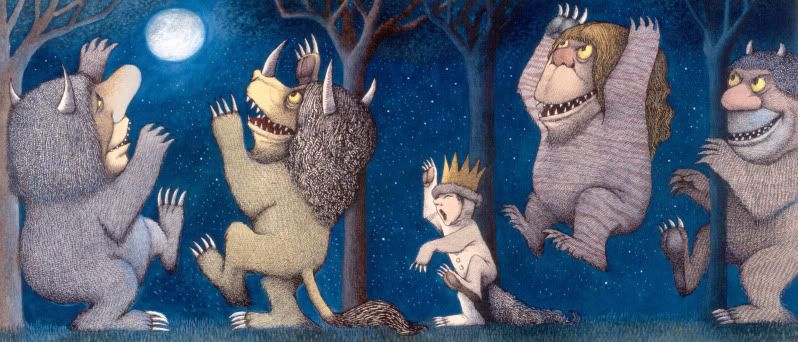
Sendak is best known for Where the Wild Things are of course, where the scolded Max, dressed in his wolf play suit, having been sent to bed with no dinner, embarks on a fantasy adventure to an island where he is King and he can have anarchic violent adventures with his new subjects. When I was little, I remember the big fuss about this book, newspaper headlines about children having nightmares, the goggle eyed, slabbering sharp toothed Wild Things, based on Sendak’s own relatives, invading their dreams. Max’s adventure captured something we all did as children, creating make belief worlds and living in them for a time.

“I believe there is no part of our lives, our adult as well as child life, when we're not fantasizing, but we prefer to relegate fantasy to children, as though it were some tomfoolery only fit for the immature minds of the young. Children do live in fantasy and reality; they move back and forth very easily in a way we no longer remember how to do.”

WTWTA didn’t pander to sentiment or the adults expectation of how a child hero should behave. Max was a naughty little monster, a normal kid, prone to excess and rages, testing his boundaries, preparing himself for life. But he also had that forgiving quality, no matter how angry you got, you always knew who loved you deep down, the anger would pass. It spoke to children at their own level, their own experience and that is why so many people love that book, it has a timeless longevity.

“I remember my own childhood vividly. I knew terrible things. But I knew I mustn't let adults know I knew. It would scare them.”

The Wild Things too, what wonderfully monstrous creations, so vivid and terrifying. Sendak gave them weight and power with his fine pencil cross hatch work.
Other interesting works

I am no expert by any means, having discovered only a small portion of Sendak’s magnificent artistic bibliography. Every time I see something new, I am delighted. The “Little Bear” books, which he illustrated but didn’t write (Else Holmelund Minarik wrote them) are another example of the beauty of his work.

My wife remembered these gentle fairy stories fondly as a child, so we bought some vintage copies a few years ago, so she could own them all again.

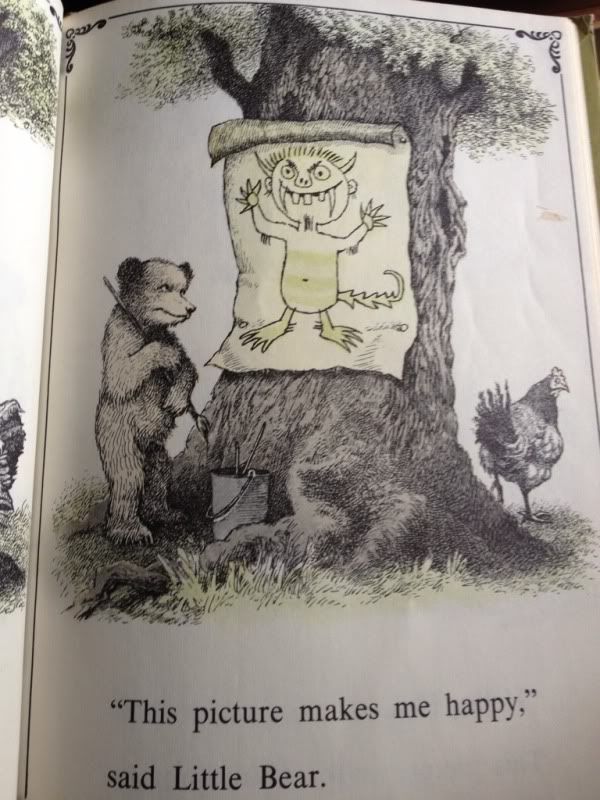
The Little Bear series pre-dates WTWTA by a few years, but “A Kiss for Little Bear” (1968) came after and has a mischievous little “Wild Thing” included within it. (images from Debbie’s first edition)
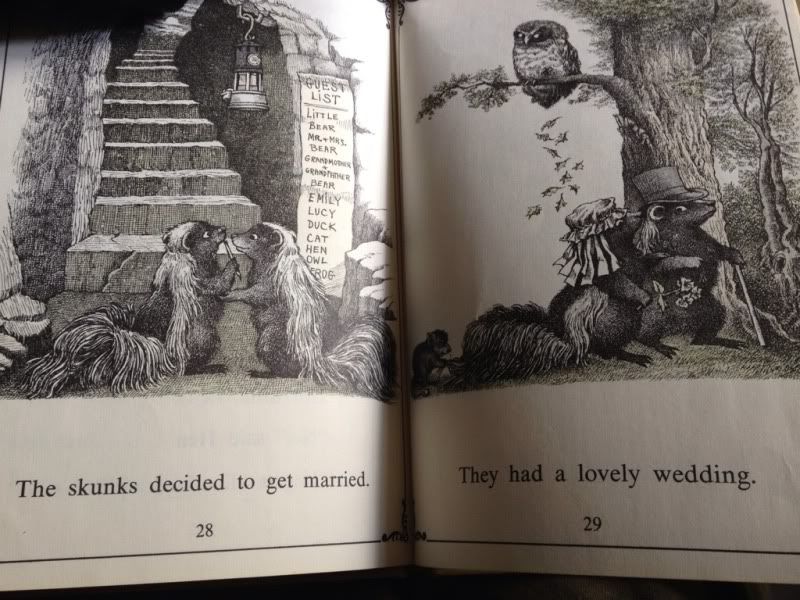
And the skunks got married, good on them!
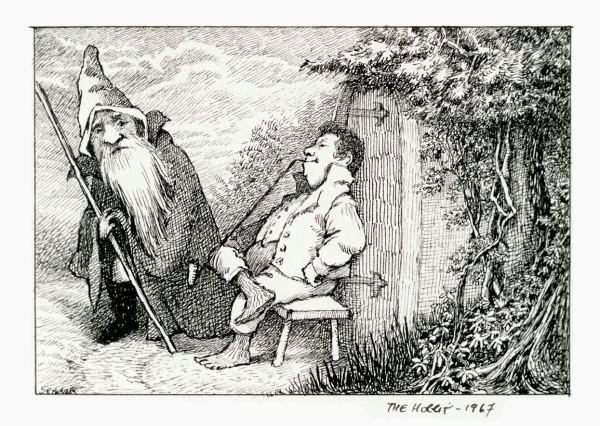
One project I was fascinated to read about was that Sendak was “tried out” for illustrating a 1967 30th anniversary version of The Hobbit, J.R.R Tolkien’s first masterpiece. He prepared two drawings, one of Gandalf and Bilbo and another of Wood Elves dancing. These were whisked off to the then 75 year old Tolkien for review.

This excellent site gives the whole story, but to summarise here, a seemingly unimpressed Tolkien dismissed the two images. Hasty efforts were made to get the two men to meet and agree to work together on what would have undoubtedly been a monumental success, but sadly Sendak (only aged 39 at the time) has a heart attack, spending several weeks recuperating. It happened on the day before they were due to meet, so the project never got off the ground.

A hint at what could have been. Gandalf and Bilbo. Unfortunately the Wood Elves drawing is seemingly lost.
Angry Parents

It’s quite fun to go on Amazon and read some of the reviews of his most “challenging” books. I say “challenging” but then this is a matter of opinion. Most children love to devour scary stuff. A parents fear projected onto a child will cause the child to feel fear. So it saddens me to read some of the comments. There’s no murder, or blood or viciousness. These are great adventure stories with happy endings, children are flawed, but heroic. And fair play to Sendak, he was utterly unforgiving and belligerent about it, as well as many other things!

“Certainly we want to protect our children from new and painful experiences that are beyond their emotional comprehension and that intensify anxiety; and to a point we can prevent premature exposure to such experiences. That is obvious. But what is just as obvious — and what is too often overlooked — is the fact that from their earliest years children live on familiar terms with disrupting emotions, fear and anxiety are an intrinsic part of their everyday lives, they continually cope with frustrations as best they can. And it is through fantasy that children achieve catharsis. It is the best means they have for taming Wild Things.”

A few years ago, I got Debbie a present of Sendak’s interactive pop up book “Mommy?” about a lost child walking through a scary house. He’s lost his mum, he’s on his own, but he isn’t frightened, far from it. Although he’s keen to find her again, he is utterly unphased by the succession of monsters which try to scare him. In fact, they get scared themselves at his pluck. What a fun book! And of course he finds his mum… so what’s the problem?

I’ve taken a photo from our copy of the book.
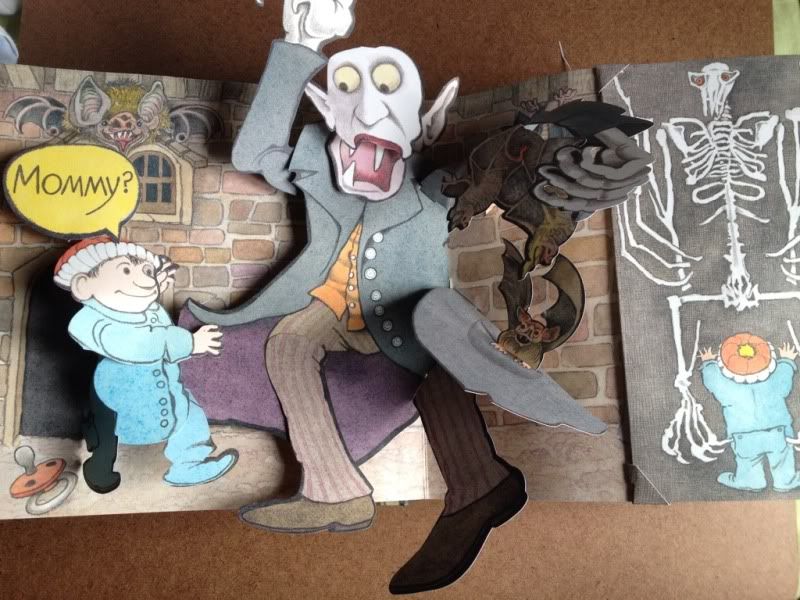
But some of the one star amazon reviews state their children had nightmares and terrors, dismissing his work as awful and frightening. Not fair.

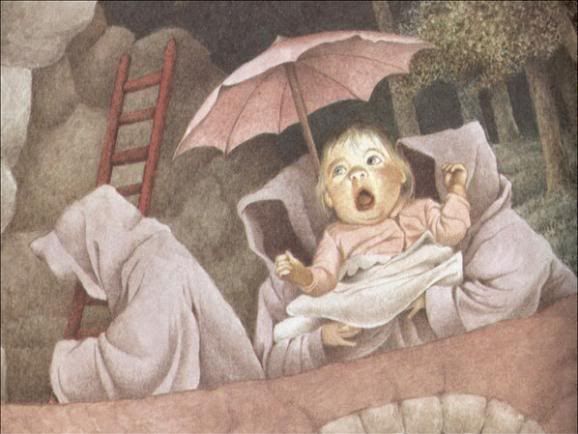
Another book I can’t wait to read is “Outside Over There”, I’m putting it on my wishlist, it’s about a girl whose little sister is kidnapped by goblins, so she sets out on a trek to rescue her. Again, quite adult themes, but this sort of adventure and escape is what children love to read.

In searching for suitable images, I came across this great link/article, from which I’ve lifted the image (credited to the publishers Harper Collins). Looking at the pictures of the faceless hooded goblins though, whoa! It is quite scary, but I’d have loved this kind of stuff as a kid!
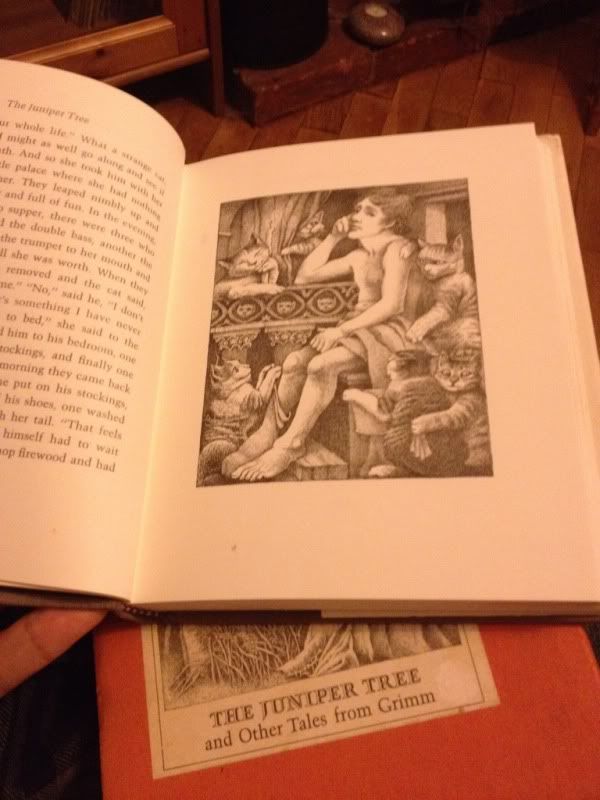
Fairy Tales are another area where Sendak has delivered a phenomenal quality of output. Take the Brothers Grimm translation and compilation “The Juniper Tree”. I wrote about this book on my Haiku blog in January. Where I revisit similar themes.

“Fairy stories are violent and frightening, full of foul acts, murders and dubious cruel characters, but with a clear lesson running through them and where normal people can be heroes. Children love this stuff, we shouldn’t patronise them by making decisions on their behalf as to what is disturbing or scary.” – I haven’t italicised the quote as I’m quoting myself, not Sendak :)
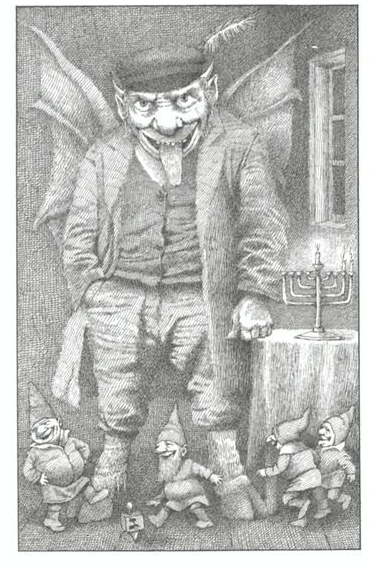
Similarly, he illustrated a book of eastern European Jewish folktales, called “Zlateh the goat”. I don’t own this, but just look at this example of the art! (image from harper collins)
Maurice Sendak didn’t come out as gay until his long term partner died a few years ago. In later life I’m guessing it couldn’t have been much of a big deal for him, but in his younger days, he wanted to keep it from his family. They were old fashioned in their attitude, they wouldn’t have been able to deal with it. That feels so sad.

“I’m gay. I just didn’t think it was anybody’s business. All I wanted was to be straight so my parents could be happy. They never, never, never knew.”

Other than the company of his beloved Alsatian Hermann (after Melville, Sendak chewed the ear off an interviewer who asked who he was named after… “Who’d you think? Goering?”) he was on his own with his memories, revisiting his literary loves. And William Blake. He wanted to die like Blake, who reportedly shot out of bed and started singing hymns seconds before his demise. Sendak’s sharp wit came through with this quote.

"A happy death..it can be done.. If you're William Blake and totally crazy.”

Going back to that Guardian interview from last year, he seemed a lonely old man. But he was ready, he was prepared to die, albeit with some regret.

And as a final quote (not from the guardian), one which seems the most poignant.

“I have nothing now but praise for my life. I’m not unhappy. I cry a lot because I miss people. They die and I can’t stop them. They leave me and I love them more.... What I dread is the isolation.... There are so many beautiful things in the world which I will have to leave when I die, but I’m ready, I’m ready, I’m ready.”

So I wish Maurice Sendak a peaceful rest. He made a lot of children (and adults!) very happy, fired their imaginations. He will continue to do so. It sounds over dramatic, but I feel part of my childhood has died too.

Saturday, 14 April 2012

Treasure Unearthed

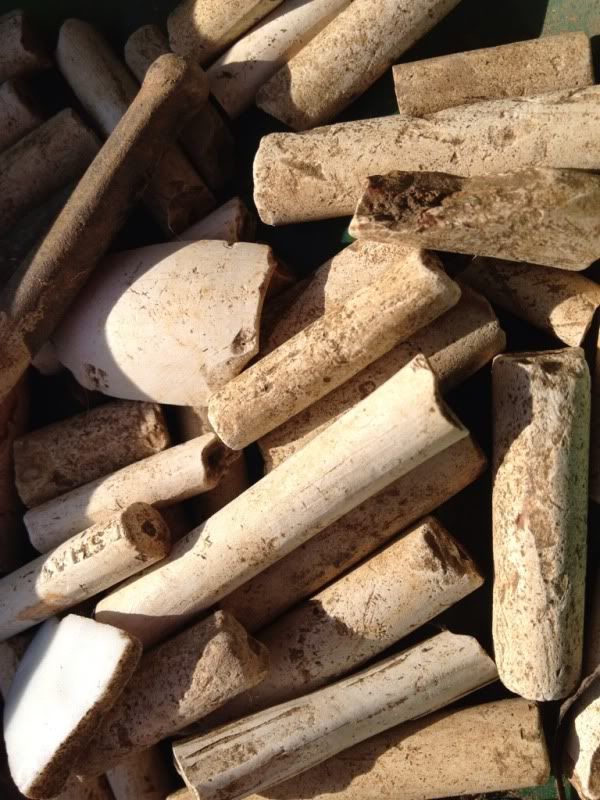
A poem. It’s about what’s hidden under the earth, in gardens and in fields. About history and people wiped from living memory. About the endless cycle of life. Accompanied by photos I took of treasure carefully recovered from Debbie’s garden and allotment digs. My favourite is the bowl handle of a clay pipe, whittled in the shape of a monkey. It feels lovely to hold, my hand wraps round it perfectly. I wonder who owned it?

Treasure Unearthed

The soup spoon churns and stirs,

Juddering in neat rows,

Dragged by the modern beast,

Delightful furrows,

Soft edged hugging the boundaries,

Buried treasures unearthed,

Chunks of scored red brick,

Fresh wounds reddest,

A wall abandoned,

Pieces of life, Where children played,

Spread thinly, rationed jam,

Smashed clay pipes, whittle marked,

Sun bleached,

Tooth white under the fallow rested mud,

Smoked thoughtfully by farm hands,

Honest fingernails filled with dirt,

Sweat dried on grimy skin,

A rest between feats of strength,

Men and horses, beasts long dead,

warmed in the same sun,

Pottery shards,

fragments of roman tiles,

A workman’s metal boot heel,

Arched jauntily, sticking out the earth,

Rusting to dust,

Little beads of faded blue bone china,

A piece of an impossible mosaic,

The scene unrecognisable,

Just a whisper from the plate’s edge,

All tiny remnants of memories,

Under all this, under stones, hints of movement,

Worms for leaping gulls, swarming, churning the air,

Grubs for suspicious crows,

Delightful furrows, buried treasure unearthed.

© Mel Melis 2012.


Pieces of broken clay pipe. In the bottom left corner, one of the shafts is inscribed with the name “SHAW”, perhaps the makers mark rather than the owners names, these pipes were commodities I believe. After a few uses, you chucked them away.

All of these bottles were dug from the garden intact! Now part of our household ornaments.

The clay pipe (this is the handle which attaches to the bowl I believe) whittled in the shape of a monkey. I’m so fond of this. I like holding it in my hand and pretend I’m smoking. How old am I? Six of course!

Porcelain and a creepy baby head

A clay pipe bowl and a pretty rabbits head skull (I think)

An old metal boot heel, probably from a workers boot. (It’s too small for a horseshoe and not the right shape)

Friday, 30 March 2012

Don McCullin, Shaped by War – Imperial War Museum

As part of my birthday we spent yesterday morning at the Imperial War Museum, where we’d bought tickets to see the Don McCullin Photography Exhibition, Shaped by War. It’s a major chronological retrospective covering his social history/poverty and commissioned photography work in the UK and in various war zones around the world.

I have to admit I only knew a little of McCullin’s work (and photography in general) prior to visiting, but I’ve always admired the starkness of human suffering captured in that shutter moment and I always think of the subject and photographer when I see an image which drags out an emotional response. What they were feeling? Whether they survived? Where are they now? Are they happy?

But not knowing much made the experience more forceful, more hard hitting. The first thing to say about McCullin is he’s in his late seventies, he lived through the war years, through poverty and rationing, through evacuation from Finsbury Park, North London. He has felt that hunger in his belly which many of us born in later years will have no concept of.

People from villages and small towns often say that they are proud of the sons and daughters of their region, when they go on to make a success of themselves. Although London is a big city, there still exists some sense of connection and community to an area within it, it may be a nostalgic or romantic vision of it (McCullin himself describes the area as tribal and violent when he was a young adult), but I still cling to some connection and love to where I’m from. Hence, having grown up in the area myself, I felt a sense of pride for Don. Here was a local working class lad who’d contributed so much to photo-journalism and to the world.

It all could have gone wrong for him though, he may have dumped photography, he pawned his camera, but his mother sensibly got it back for him.

In the thirty minute film which is shown as part of the exhibition (see extract below), McCullin comes across as being haunted by the sense of making a living through tragedy. The first tragedy which got him into a career in photography was the murder of a policeman by a north London gang. As he was an associate of a gang himself, he took photos of his friends, he sent them to the Observer and they published them. A window into this (probably) hidden working class world of 1950s urban violence must have fascinated the broadsheet buying public. And that kick started his career.

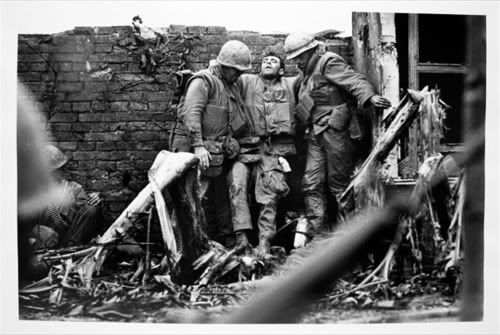
He doesn’t claim he’s a good guy, and in no way is he a bad guy… there are times when he personally performs great feats of courage or dignity (carrying a wounded G.I in vietnam), there are other times when he says (I paraphrase) he feels repulsed by his feelings towards war, needing it and being enthused by it. It’s an uneasy and unsettling ambivalence, balanced between revulsion and guilt and the absolute conviction of making sure people had a voice in the world, that tragedies would be brought to the public attention.

In addition, he has a deep sense of value for his work, he sheds this peculiar British notion of self effacement, denying or putting down value in your own work. He positively knows his work is excellent, he has invested so much in it, so much skill and feeling, but in no way does it come across as an arrogance, or a blind spot to some hidden weakness. He puts everything into it, he wants us to feel, to become involved. His weakness is one which he is painfully aware of, the guilt he carries for what he has seen and photographed. I suspect he feels this pain every day of his life.

His mistrust of humanity stems from what he has seen. As he states in the interview, he keeps his loved ones close of course, but witnessing such unimaginable horror has made him suspicious to the point of avoiding human contact it seems. In recent, non war related work, he seeks solitude through the photography of landscapes, in what he describes as healing. He wants people to fall in love with these photographs. And in the exhibition, after the harrowing images of war, there are some beautiful landscape images which appear gently at the end, a kind of reflection, a small balm, a little reminder that there is beauty in the world.

But, what one man can inflict on another without any mercy or compassion has forged him. His story of his experience in Vietnam sounds like hell on earth. Being surrounded by corpses, sleeping and waking up finding you’d inadvertently slept beside a corpse, jumping into a hole to hind only to find you are sitting on the belly of another corpse, but still maintaining an ability to take photos. It shook him, drove him to battle fatigue, it would have tipped most people over the edge, whether they were fighting men or not. His image of an American solider, having been badly wounded in both legs is one he describes as reminiscent of one of the most iconic images in the western world. That of Christ being brought down from the cross by his loved ones.

McCullin’s has been quoted as saying : “I am a professed atheist, until I find myself in serious circumstances. Then I quickly fall on my knees, in my mind if not literally, and I say : Please God, save me from this”

And it’s not hard to imagine investing frightened prayers for salvation when faced with such chaos and murder all around.

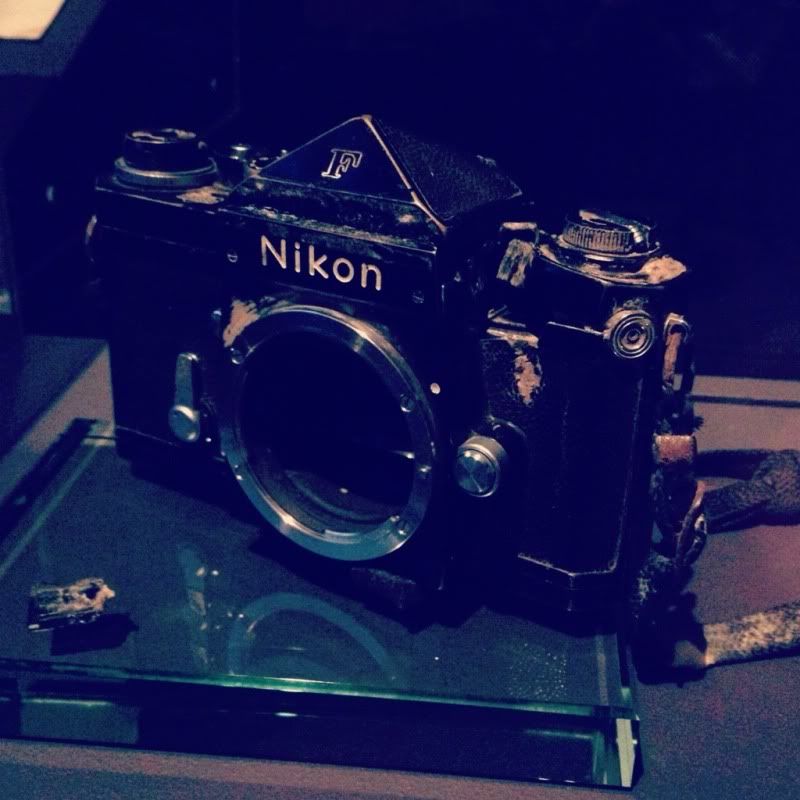
Pic I took of McCullin’s camera which copped a bullet for him. And it still works!

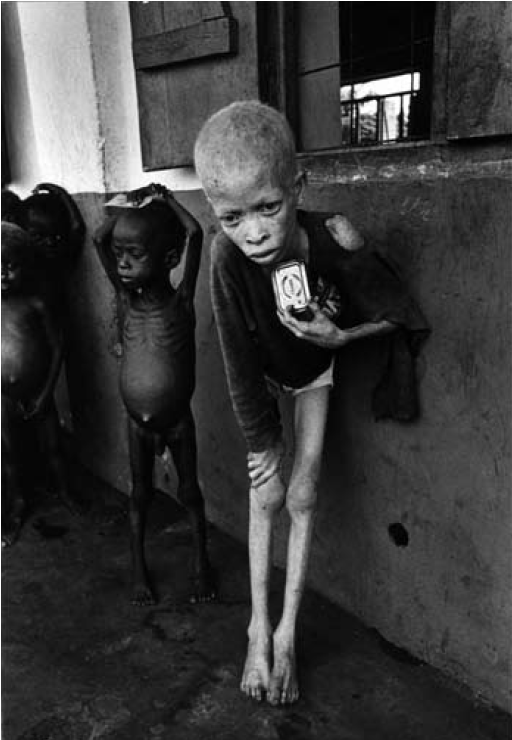
I have to say, going to this exhibition, you cannot be anything other than emotionally involved with the suffering and sadness he has captured. Not just because of images of fighting, but because of images of the victims of war. The hollow shell of the fragile oprhan albino boy from Biafra, not only starving, but shunned because of his condition, dressed in rags.

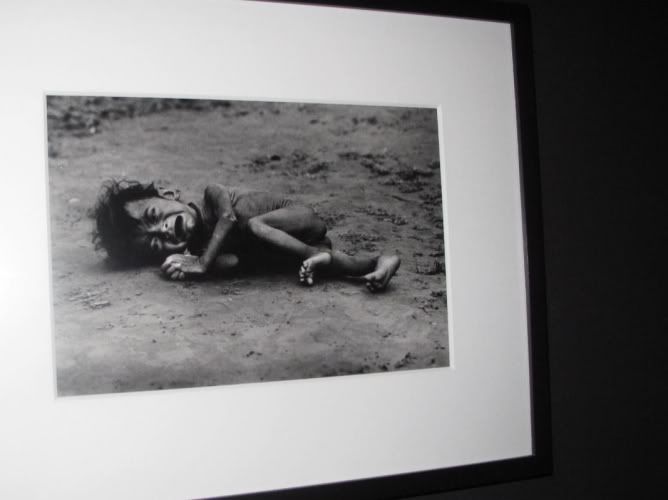
Or, the picture of the abandoned child in Bangladesh in 1971. This child would be about the same age as me. I haven’t stopped thinking about him or her since looking at this photograph.

(photo of this photo from thedrum.co.uk)

Finally, the final part of the film “The Darkness in Me” where Don McCullin talks of his later years and finding peace. It contains some disturbing, but also beautiful images as he talks about overcoming or at least controlling the darkness in him. The other three parts are also on youtube.

Shaped by War is on until the 15th April.

Sunday, 18 March 2012

Mark Lanegan, Shepherds Bush, Tuesday 13th March 2012

I have to say I was very excited to hear Mark Lanegan had recorded a new album and was touring. And not just a new album, but a Mark Lanegan Band album, his own compositions. We’d waited eight long years between 2004’s Bubblegum and this years Blues Funeral. In between Mark busied himself with collaborating, his growl added to the work of Isobel Campbell, The Gutter Twins and Soulsavers. It was like this work kept him in touch with the musical world, on a low intensity, whilst he hibernated like a ruminative bear incubating his own songs.

And after this long hiatus, the new album, it’s when he has his own voice that his songwriting, his under appreciated poetry, his music and his vocals really come to the fore.

Blues Funeral is great, full of the expected dark gospel and gothic blues as well as big rumbling rock numbers. But scattered throughout that mix are some uplifting lyrics. There were always references to religion in his lyrics, an evocative hook many singer songwriters latched onto, whether they were religious or not. Lanegan’s past (although he doesn’t dwell or want to discuss it) is one which looks to be scattered with regrets and tragedies, addictions, jail and poverty, this comes through in his songs, so when he roars the following on the powerfully raucous “Quiver syndrome” it does verge on the Christian Rock (and I don’t say this in any derogatory way, as it’s a brilliant tune, but when I catch myself singing along to it I do smile at the thought of the arch-agnostic getting right into it!).

“Will the lord hold me down, because I’m wicked? Will the lord hold me down, to my shame? Will your love it get into me jesus? Now I heard you calling out my name.”

And the almost Goldfrapp like “Ode to Sad Disco” is another one, an uplifting song with a synth groove running through it, has lyrics relating to seeing the light and being on your knees.

But of course, there are also classically dark songs, like the opening track of both the album and the gig. “The Gravedigger’s Song”. The video draws on so much of the horror genre, it should have an 18 certificate :)

So, onto the gig. I met up with the Bossman and we got to the venue early enough to catch the last couple of tracks of the first support act Duke Garwood. With perseverance, his disembodied blues with almost unintelligible lyrics was compelling. The already large crowd (it was a sell out) watched respectfully as he occasionally plucked or strung out a lyric whilst his equally hirsute percussionist trudged away in the background.

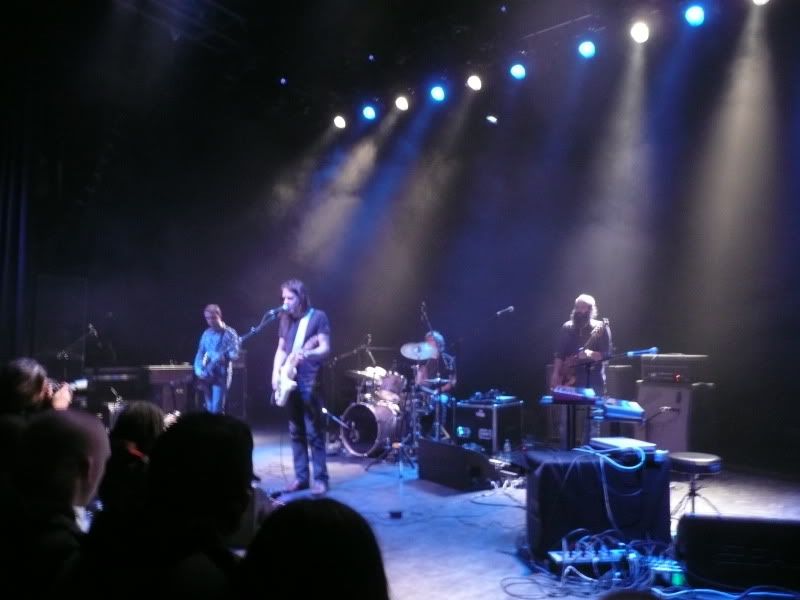
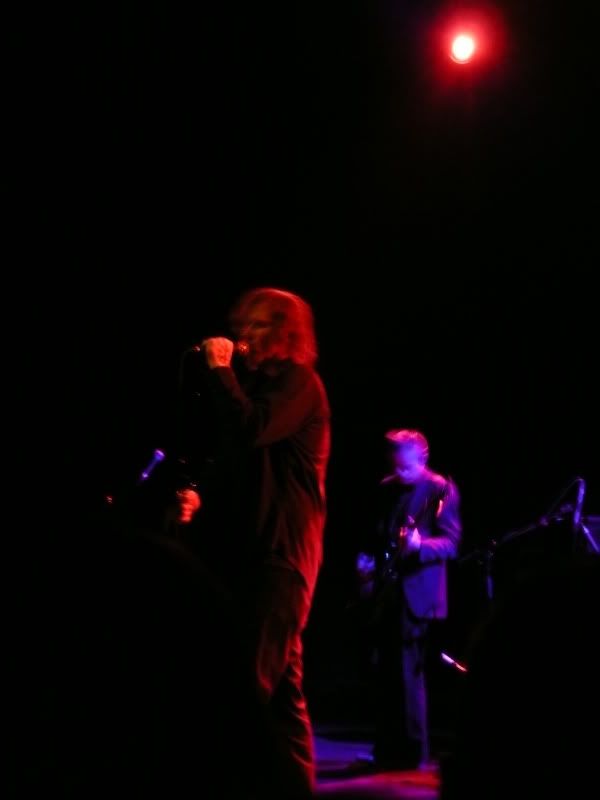
After Duke Garwood, the Creature With the Atom Brain, a psychedelic stoner rock band from Belgium. They were brilliantly tight. Really enjoyed them. Here is a pic. I particularly liked the bassist as he looked like a Greek priest with his hair in a bun and his big beard :)

And then to Mark Lanegan himself.

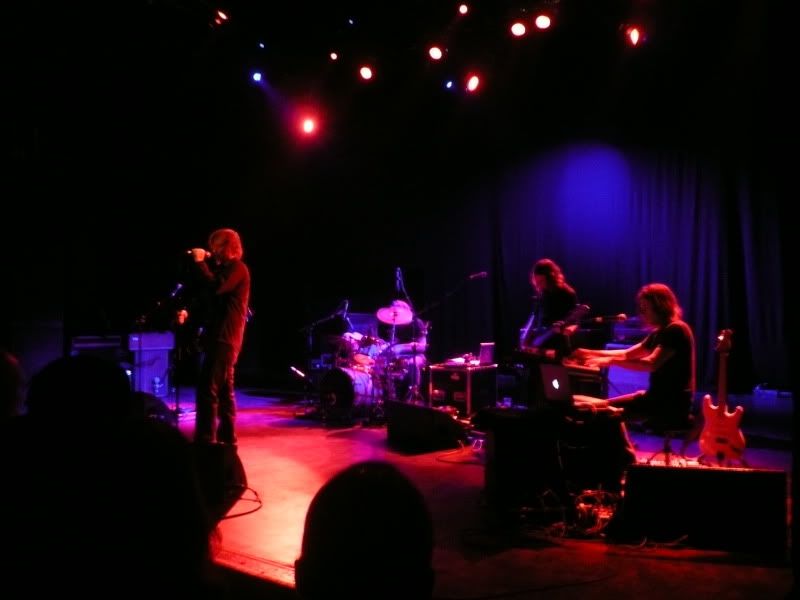
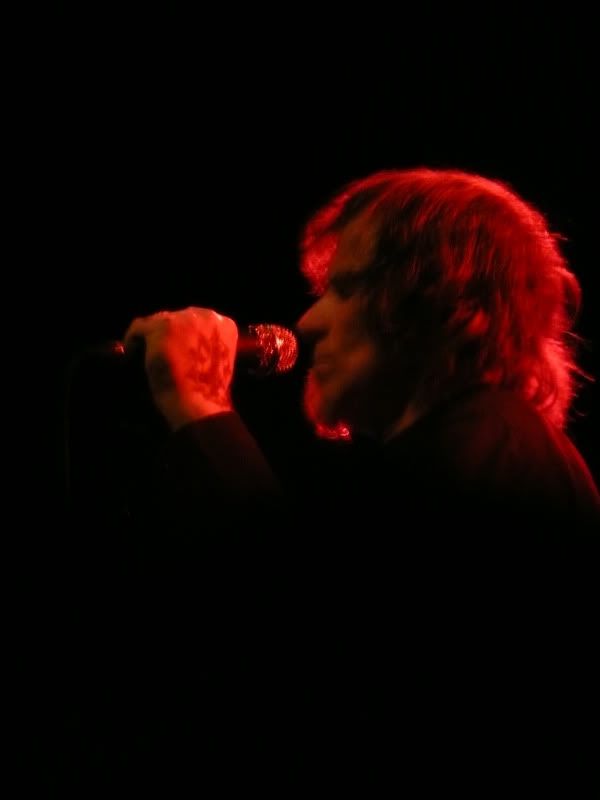
He is a man of few words, he doesn’t have much to say beyond the songs themselves. But some people in the audience want to hear some stand up it seems. “Give us a smile!” someone shouted. Lanegan didn’t flinch or react. Just enjoy the music dudes! He stood in his familiar pose, one hand fixed high on the mike stand, his crucifix tattoo visible on his fist, the other hand gripping it lower down, like he was clasping to it for dear life.

Songs of death, regret, attempted suicide, drinking, depression, addiction, love, lost love, cruelty, despair. His lyrics are moving and powerful. When he did speak, it was just to mumble the occasional thankyou. When he introduced his band, he seemed crippled by shyness and self doubt. For someone who bares their soul through their lyrics, just genial engagement with an audience tests him. I’ve no problem with that. In fact, it’s endearing. We all have our doubts and challenges. The fact he came out to sign stuff for the audience after the gig must have been difficult for him too.

All in all, including the encore, the band played twenty tracks, new tracks and some classic old ones, such as “One Way Street” from my favourite Lanegan album Field Songs. Bubblegum was also well represented, another great album, often cited as his best. It was a mammoth performance, he poured his heart into it. Lanegan sweated like a beast, sweat poured down through his beard, onto his shirt and the floor. His big leonine head occasionally rocked, his face grimaced as the storm raged around him. Some lyrics seemed painful for him to sing.

When it came to the first encore track “When Your Number isn’t up” a song about loneliness and a botched suicide attempt (I don’t know whether it was his own) he sounded particularly vulnerable. It was moving hearing this song live.

When your number isn’t up (Mark Lanegan)

Did you call for the night porter?
You smell the blood running warm
I stay close to this frozen border, so close I can hit it with a stone
Now something crawls right up my spine
That I always got to follow
Turn out the lights
Don't see me drawn and hollow
Just blood running warm
No one needs to tell you that
There's no use for ya here anymore
And where are your friends?
They've gone away
It's a different world, they left you to this
To janitor
The emptiness
So let's get it on
When the sun is finally going down, and you're overdue to follow
But you're still above the ground
What ya got comin' is hard to swallow
Like blood running warm
Did they call for the night porter
And smell the blood, blood running warm
Well I've been waitin at this frozen border, so close you could hit it with a stone

It was swiftly followed by Pendulum, a song about Jesus, his sacrifice, loneliness (again), drifting and homelessness. Then Harbourview Hospital, from the new album, about redemption and personal demons and finally the massive Metamphetamine Blues. People saved their moshing for the last track of the evening.

It seemed apt the last words he sung were “I don’t want to leave this heaven so soon”.

Saturday, 3 March 2012

Adam Cohen, Union Chapel, Feb 29th 2012

For our Christmas present, my lovely niece Dod got me and Deb tickets to go and see Adam Cohen, as in son of the legendary Leonard and not just that, but at the aesthetically beautiful Union Chapel in Islington. Six of us went, a collective noun of Greeks. A gaggle (Deb is honorary Greek now).

We’ve seen Cohen senior twice, one time was at the Royal Albert Hall where we lucked out on front row stalls tickets, which was utterly brilliant. A magical occasion where his humility moved the audience. The first time was in Dublin and I wrote about it in this post. I would wax lyrical about the genius that is Leonard, but this blog isn’t about him, it’s about his son and much as I will try to avoid comparisons, sometimes they are unavoidable.

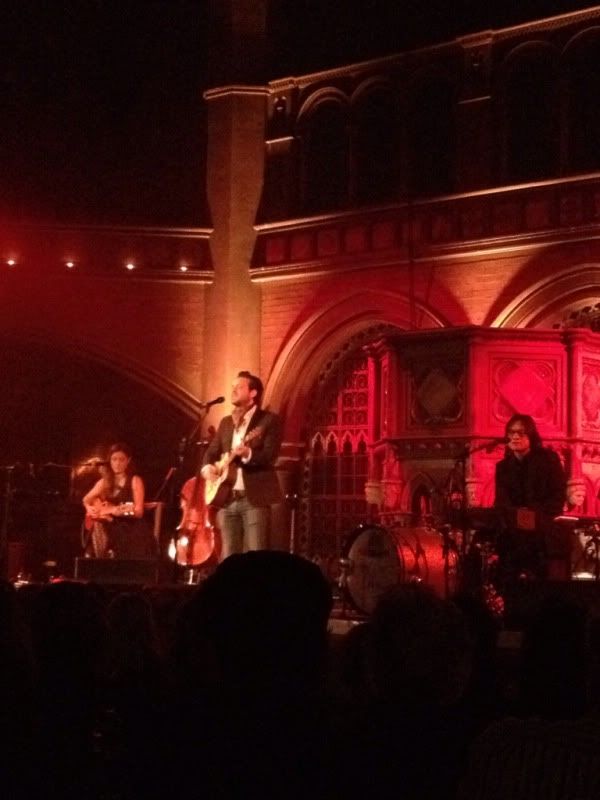
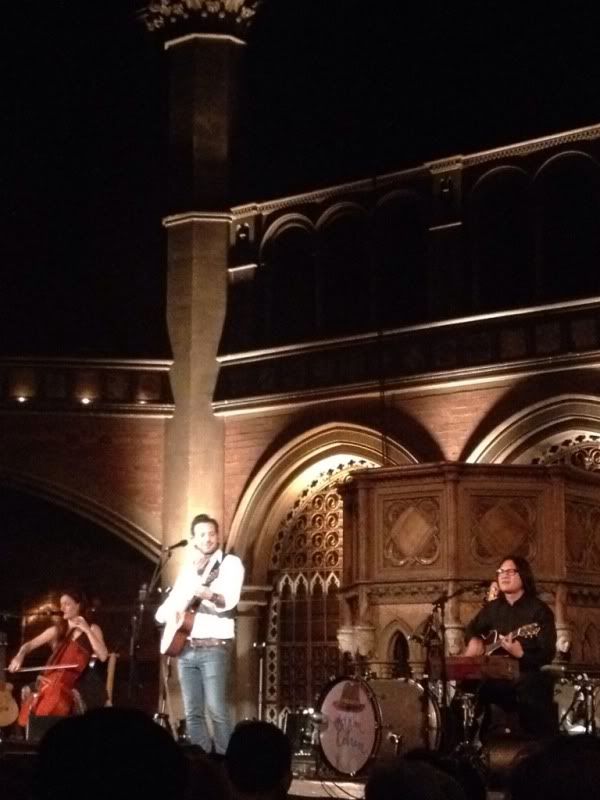
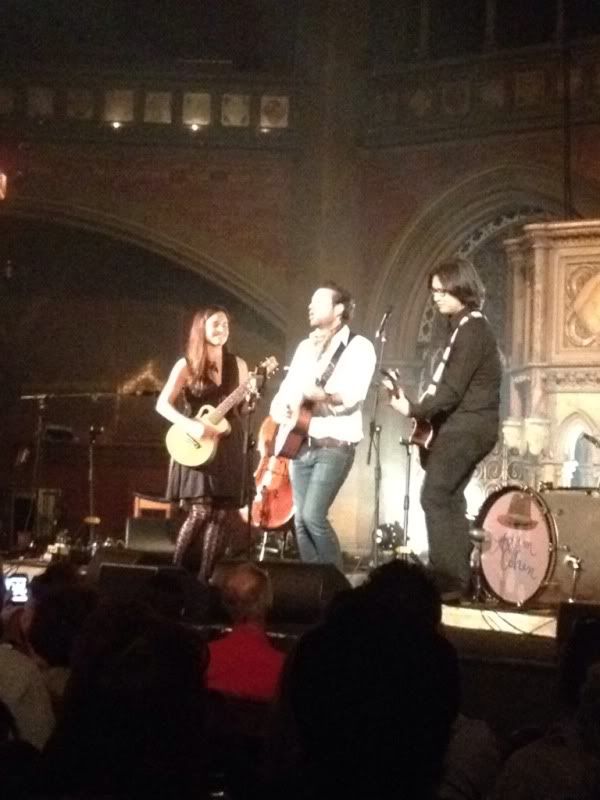
After the support act, who incidentally I liked, Scott McFarnon, a sincere, easy going singer songwriter, Adam strode onstage in a formal jacket, his jeans looked perhaps one size too small for him, a white shirt, with a perfectly folded cravatte tied in a triangle round his neck. Why is all this detail important? Well, because it seemed important to him. There was something vaudeville about him, the way he lounged out, holding a tumbler of tequila. As Christina said, he looked like he was doing an impression of Al Murray as the pub landlord. I thought he was more like the Fonz at times, always on the verge of sticking both thumbs up and saying “eyyyyy Mrs Cunningham”. His band consisted of two other members and together they were flawlessly tight.

So what were we in for? His songs contained hallmarks of his fathers genius. The syrupy depth of his voice, the poetry of lost love and layers of perfect vocal harmonies. Some of his songs were beautiful too. His first few songs cited the names of various ex-girlfriends. This got a bit grating as it seemed he was exultant in the power and content of his tightly packed trousers as much as the despair of losing these various beautiful former loves.

But beyond the showman was a great performer. He warmed up and he warmed us up. The times he did honour his father with a cover version or a snippet of a cover version, I struggled, but eventually gave in (So Long Marianne, Tower of Song for instance). He wasn’t the toddler trying to stand in his dads immense shoes, it felt more like him respecting his dad. And why not, they are his inheritance and something for him to be rightly proud of. 

Saturday, 18 February 2012

Persian Fire, Rubicon and Millennium by Tom Holland

As a keen amateur dabbler in the short story area and having stumbled over the corpses of several fizzled out novels, advice that is often lobbed in your general direction is to Read, Read, Read… read other authors, let other authors amazing skills ooze into your pores and by osmosis you will be at least enthused if not influenced to write better.

Sod that. Much as I like fiction, what I usually end up reading is narrative history. I respect writers in this area because they combine both;

1) The painstaking effort in the meticulous research required to build their book, balanced with-

2) Being actually able to write, be compelling, tell a story, without actually making it up or losing the determination to get to the end of the project.

These are two very different skills, they almost pull at each other, opposing forces, so if an author can achieve both, seemingly effortlessly, then this makes for a good book.

And Tom Holland really hits the spot in both areas. I’ve read approximately 2.9(!) of his books so far (I’m just coming to the end of Millennium) and I have to say all three books are excellent, the others being Persian Fire and Rubicon. There’s a fourth on the way too.

My well thumbed copies of Tom Holland’s books. Guaranteed to make you appear to be erudite and wise when visitors appear and you lean against the bookshelf they are housed in, your other hand ruminatively holding the pipe you are slowly puffing on.

To keep you on your toes, he also inserts a little fact or reference to make you smirk along the journey, to perk you up, some humour to go along with the hardships, glory and despair of the realities of conquest and war. Stuffier authors might consider these facts unnecessary or lacking in historical worth, but for me, they paint a picture. Of what the goss’ was back in the day. Of what people were saying, this is just as important as the actual facts to me, to get to grips with the psychology and motivations of the protagonists, their contemporaries and enemies.

Examples, from memory, Greeks looking down on the Persians as effeminate as they wore “trousers”.

Or where he cites (in Millennium) one of the stories of how Sweyn Forkbeard assassinated his own father Harold Bluetooth to take the Danish crown, through shooting him “square between the buttocks with an arrow” as his old man was “squatted down behind a bush for the purpose of emptying his bowels”. Which may or may not have been the way it actually happened, but brilliantly enlightening that someone saw fit to spread this rumour about back then!

To someone who had a wholly vocational education from the age of 13, who is only catching up on the arts and history I would have thoroughly enjoyed as a kid, it’s also educational without being patronising. There’s a childlike wonder when I consider the origins of words. Like “ostracised” coming from the Greek “ostraka” meaning the broken pieces of pottery on which voting Athenians would scratch the name of their choice for expulsion from Athens, a kind of inverted voting system, which clearly the classically astute producers of “Big Brother” studied deeply in the development of their TV programme :)

Or as covered in Rubicon, “decimation”, the ugly way the Roman’s would punish a failing army, by randomly picking every tenth man and having him executed in front of his comrades. How terrifying. And how this possibly could lead to a rally in their morale or improvement in their fighting ability I have no idea. But this is another thing Holland expertly points out. How people thought in that period was significantly different to how we think now. Modern morality is built upon an Abrahamic foundation, whether you are religious or not. The Romans, Greeks and Persians seemed unencumbered by such “trivialities” as compassion or forgiveness. Sure, they loved and they grieved, but their motivations were different to ours, as Holland himself states in the preface of Rubicon:

The Romans, it goes without saying, existed under circumstances – physical, emotional, intellectual – profoundly different from our own. What strikes us as recognisable about aspects of their civilisation may be so – but not always. Often, in fact, the Romans can be strangest when they appear most familiar. A poet mourning the cruelty of his mistress, or a father his dead daughter, these may seem to speak to us directly of something permanent in human nature, and yet how alien, how utterly alien a Roman’s assumptions about sexual relations, or family life, would appear to us. So too the values that gave breath to the Republic itself, the desires of its citizens, the rituals and codes of their behaviour. Understand these and much that strikes us as abhorrent about the Romans, actions which to our way of thinking are self-evidently crimes can be, if not forgiven, then at least better understood. The spilling of blood in an arena, the obliteration of a great city, the conquest of the world – these, to the Roman way of thinking, might be regarded as glorious accomplishments. Only by seeing why can we hope to fathom the Republic itself.

In that vein, my favourite of his books, Persian Fire, explored the vast differences between modern and ancient peoples, but also the vast differences between Greeks and Persians, and finally the vast differences, the bickering in-fighting and wars between the Greek speaking peoples themselves. A Spartan was as different to an Athenian as he would be to a Persian. There seemed to be a deep mistrust.

The words “Laconic” and “Spartan”, in popular use today, stem from the behaviours of the residents of Laconia, of Sparta, built for war, with their economy of words, unsympathetic to weakness, to their own children, wearing nothing more fancy that a red cloak wrapped round their shoulders (when they earned the fighting right). A red cloak, a symbol of athletic power, of skill in battle, that struck fear in kingdoms and city states from near and far. I’m generalising, but diplomacy wasn’t something they considered worthwhile investing in. They were insular and warlike.

The Athenians on the other hand, seemed duplicitous, full of intrigue, making bargains and deals, loving a bit of old chit-chat, philosophising and speculating. This “democracy” they had invented seemed alien to all outsiders that would witness it. Dangerous, worthy of being crushed in case it caught on (of course it was only elite men who got the vote). After all, a hero could become a villain overnight and be cast from Athens, based on some tenuous slight or perceived mistake. Shockingly, even Themistocles ended up ostracised, that hero of the Persian wars with his “wooden walls”. But being a fickle Greek, he ended up working for the Persians as a special advisor on Greek matters. Being of Hellenic stock myself, I can picture him being flattered by the interest, coyly turning his bull neck, a one time enemy becoming a trusted confidante. I hate to use this analogy, but I will anyway :) … Like football managers in the modern era, you were only good as your last result in ancient Athens.

And the Persians, with their splendour, their armies from all of their nations, the real Empire of the day, gigantic compared to the flea that was Greece on the fringes of their borders, nipping at the thick golden hide of the ever hungry Persian beast. Persia’s seemingly benevolent King, making nothing more than a demand of “earth and water” (in the form of gold levies and soldiers) from the nations he conquered, letting them maintain they culture and ways of life as long as they maintained a loyalty to him. They absorbed the interesting aspects of the conquered cultures rather than destroying them, but were happy to destroy if the subjugated nation ended up too meddlesome. The Persians had seemingly been delivered a disservice by the crowing Greek chroniclers in the aftermath of their setback at Thermopylae and defeat at Platea, dismissing them as barbarians but Holland gives them an even handed assessment. It’s interesting in a modern context, had the Persian’s conquered Greece, would modern people be looking at Democracy as some quaint old folly, long since disposed in the dustbin of antiquity? And in the context of fledging democracies today, is it better to live safely and with relative wealth under a tyrant, on the understanding that you give complete subservience and don’t have an opinion. Or do you opt for the dangers of the chaos and danger that comes with that fledgling democracy? I wouldn’t be so arrogant as to make any assumption as to what hardships the people of Iraq or Libya (and even the poor and unemployed within the old Soviet states) are going through now or when they lived under dictatorship, or what decision they would make if given the choice to go back to what they had. But it leads to an interesting consideration.

I have very fond memories of Persian Fire as I read it on my honeymoon, which I shared not just with my wife, but with Themistocles, Leonidas, Cyrus, Darius, the Oracle at Delphi, Xerxes, the enslaved Helot underclass and the horsemen of the Medes. As I read it, on our hillside cottage in St Lucia, I’d occasionally take a sip of some cocktail, or watch a hummingbird flit around the lush flowers. It was a beautiful week.

Holland gives a history of Sparta, Athens and Persia, sets the scene. It’s a quite amazing story, considering the majority of Greek states chose to (seemingly wisely) side with Xerxes and his gigantic army. And yet, two distrustful, diametrically opposed Greek states, sharing only a language, Gods and heritage, formed an alliance with a clutch of other Greek cities, to defend or be crushed against their common enemy. Luck played its part, but from a historical context, it seems almost miraculous that these small armies and navies (Athens had no real maritime history at that point but made a huge investment to train and create one based on the Oracle’s “wooden walls” advice and Themistocles belligerence) could defeat the power house that was Persia.

I have to say, it’s one of my favourite books, fiction or non-fiction.

My final point is that this probably isn’t one of my better blogs, it’s a bit stilted. It’s because I’m having to research and quote and try to avoid naive conjecture which means it doesn’t flow very well. It just shows, even with the books sitting in front of me, I’m just not very good at detail *and* entertainment. I don’t think I could write narrative history without resorting to embellishment (I even did it with Themistocles making flirty eyes at the Persian’s above!), outrageous lies, or losing all faith and giving up.

Tom Holland however, is an expert, so really, you should go and buy his books and take my word for it :)

Sunday, 12 February 2012

Art by Animals, Grant Museum of Zoology, UCL

I popped into the Grant Museum of Zoology, a compact little treasure trove I hadn’t ever visited before. It’s part of a group of museums which is part of University College London. The museum itself is, I would guess Victorian, all wood panels and cabinets in a single room, filled to the brim and all the way up the walls with specimens and skeletons of various living, rare and extinct creatures. I wrote a Haiku about my visit in my other blog. Charles Darwin was a one time resident in Gower Street too and there are blue plaques aplenty dotted around this academic hub.

At the moment, there is a temporary exhibition on Art by Animals. Here is a short clip from UCL summarising it.

Animal Art is a fascinating area and the museum has not just displayed the pieces by Primates and Elephants, but provided some background to the (possible) thought processes that accompanied the creation of them and speculate as to the development of art from our primate ancestors. From the subconscious/abstract/impressionistic to when art became more representational in our history.

It truly is interesting. I’m not going to get into any debate as to “what is art?”, I’m just a hairy, low slung assed, bow legged primate myself, my interest was imagining what the thought process of the animal was. Were they enjoying what they were painting? Or was it purely (as possibly exhibited by the behaviour of the Orang-Utan in the clip) just a ploy to ensure they get a treat? Was it free associating? Were they making definitive choices on colours to use? Is the aesthetic quality important to them? And most exciting (to me anyway!), are they trying to represent something?

The museum itself talks about the “What is Art?” question in some of the exhibits, for example the Bowerbird, creating one of the most achingly beautiful structures in the animal kingdom to attract a mate. They then lovingly fill it with similar coloured items stacked together, such as iridescent beetle shells or flowers or even blue plastic bottle tops. Is this art? How did this behaviour evolve? Well, probably not art I guess, but work of this nature inspires us to make art in its honour and feeds into the question of Primates. When our ancestors witnessed something they didn’t understand, of this nature, which made them fearful, astounded or think about more than the desperate need to survive, did they then take a step further in their thinking, to worship celestial beings and Gods and make them want to honour these deities themselves through the creation of art? Apologies for the hack anthropology! But shit like this does keep me awake at night!

image from bbc website

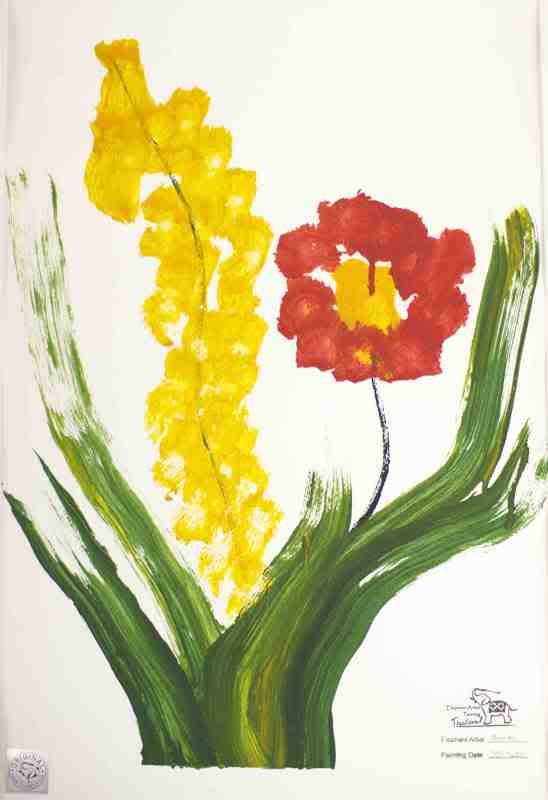
The first piece of art I saw made me gasp, the fact it was made by an Elephant staggered me. Beyond the obvious motor skill, the hand(trunk)-eye coordination in making the painting, there was another question. Was it possible for an Elephant to directly represent still life through paint on a canvas? Were they inspired in any way to do this? This opened up a whole ream of possibilities, how intelligent are Elephants? How sensitive or emotional? And do they appreciate and take comfort from art?

(painting by Boom Mee)

Unfortunately, the Elephant is guided, as it states in the clip, his or her handler manipulates their ear like a joystick, to get them to paint something they, the handler want represented. Does this make the art inauthentic? I don’t think that matters, especially if the Elephants are not mistreated in their training and the art itself is sold to raise money for Elephant charities, it just shows that an Elephant has incredible skills in translating commands from touch, into making an image. So it doesn’t diminish it’s interest value for me.

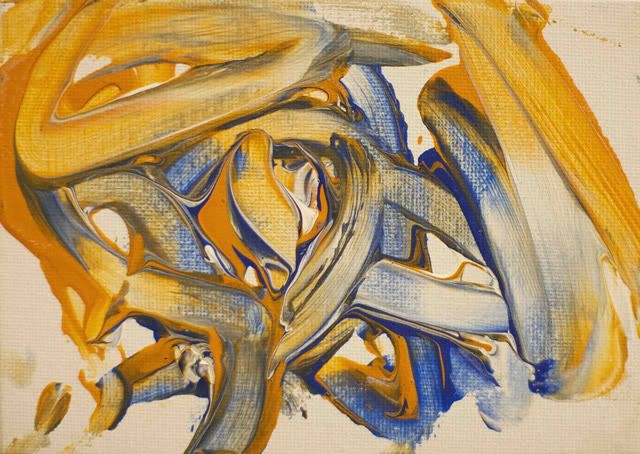
So, onto the primates. The below is a painting which forms part of the exhibition, by a chimp called Bakhari at St Louis Zoo. It’s a finger painting. Interestingly they exhibited it upside down in the Museum! Or is the photo upside down? Did no one think to ask Bakhari as to which way up he wanted it?

(by Bakhari)

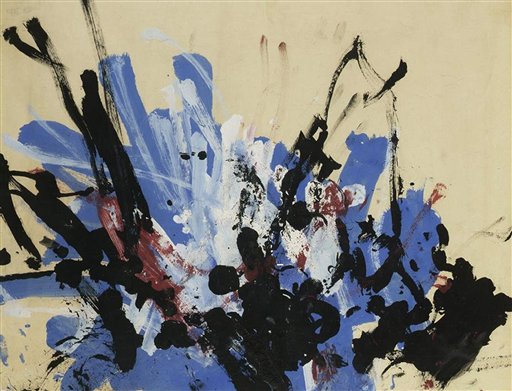
In terms of expressionistic value, I really like this. There was also an exhibit of a Chimp’s hand which was used to introduce the marvel of the London Zoo based Chimp, Congo, who even had his own exhibition at the ICA in the 1950s! Three Spanish giants of modern art also had a role to play in Congo’s artistic career;

- Dali who exclaimed “The hand of the chimpanzee is quasihuman; the hand of Jackson Pollock is totally animal!” when witnessing one of Congo’s canvasses.

- Picasso, who secured one of Congo’s paintings as he loved it so much.

- And Miro, who on hearing that Picasso had an original Congo painting, wanted one for himself, which he then swapped for two of his own drawings!

The fascinating article is here and below is a short clip with the great Anthropologist/Zoologist Desmond Morris on his experience of showing Miro round London Zoo when the artist was a venerable man.

As for Congo’s work, unfortunately they aren’t on display in the Grant, but I have to say there seems to be a deliberate method to Congo’s art, it was certainly worthy of his own exhibition in my opinion. I would be delighted if I owned one too! And the story of Congo’s work outselling Warhol in a 2005 Christie’s auction made me laugh, Congo had the honour of being the first non-human to have their artwork auctioned at such a prestigious establishment.

(wikipedia image)

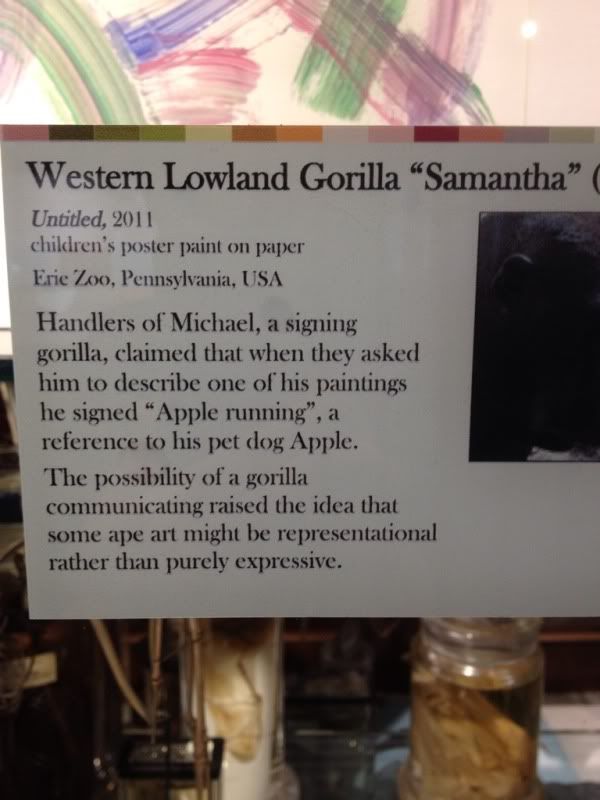
As a final note and going back to the question as to whether primate art can be representative and not just abstract expressionism, this little note, cheekily secreted in the description by a painting from another gorilla made my jaw drop (in that unique ape jaw style). A gorilla, who could use sign language, when asked what his painting was of, signed back that he’d painted “Apple Running” – Apple was the name of his pet dog. So was this truly a first? A breakthrough in understanding what goes through a great ape’s head when he paints or when he thinks? That he was actually representing a concept in his art? I find that incredible.

Art by Animals continues until March 9th 2012.

Followers