Friday, 23 November 2012

The Magnetic North, Purcell Rooms. “Hunting for Remoteness”

Last night me and my mate John from work went to see the marvellous Magnetic North at the Purcell Rooms on the South Bank. It’s a project pulled together by Orcadian musician, Erland Cooper (of Erland and the Carnival), in collaboration with Hannah Peel (who released her own solo album and is part of John Foxx and the Maths) and Simon Tong (previously guitarist of the Verve/Gorillaz)

It would be a disservice to try to pigeon hole the album they’ve written (Orkney: Symphony of the Magnetic North) but twist my arm and I’ll suggest it has elements of folk, electronica with subtle pop sensibilities, it hints at sadness, loss, nostalgia. There are soaring uplifting waves which soak into you, evoking the spirit of the album, the wind swept barren beauty of the Orkney islands and young Betty Corrigall, the seventeen year old “Orcadian girl who in the 1770's killed herself having been cast out by her village after becoming pregnant by a visiting sailor.” – quote nabbed from the band’s facebook page.

The evening started with the debut of the film Hunting For Remoteness, which complements the album. Prior to the film being screened, I could sense a nervous shuffle in the seat next to me, John, the big Yorkshireman, let on that he would love to take his family on a holiday to Scotland, but something has always stopped him, a deep seated fear. His cultural references of remote communities in Scotland are based on only two sources; the films The Wicker Man (the original, not the dreadful remake with Nicholas Cage) and Lars Von Triers Breaking the Waves. Also, and he didn’t admit it, but I could tell, he subliminally feared Mel Gibson’s Braveheart character too, the frighteningly outrageous mullet, the blue face paint and the tightly defined calves, built from years of wearing high heels…

But I believe the beautiful film allayed these fears for him, no ritual sacrifices or having your head stoved in by a swinging oil rig boom which drives your loved one to speak with the voice of God and commit tragic acts of self neglect. (sorry, spoilers)

The film was beautiful, it reminded me a little of Sigur Ros’ film Heima, the way the music, the musicians, the land, folklore, history and the generosity of the local people were intertwined in the creation of the songs and music, directly when a local choir contributed to the album. The story of poor Betty is particularly sad, the band members making the pilgrimage across the heathland to find her remote gravestone, far apart from the community, the churchyard, the consecrated ground, away from her family even in death. Erland says Betty visited him in a dream, asked him to write an album about Orkney. Well I’m glad he took her advice! The film was gentle, occasionally funny, very moving, mixing locals’ commentary, soundbites from the band members, extracts of recording and performance, but also interlaced with the staggering beauty of the islands and that nature that inhabits them. I’m certainly sold on spending a holiday there (and I think John is too). The people, the landscapes, the history, it just sounds perfect for someone who wants to get away from it all, do some walking, exploring and resting (which is mine and D’s favourite sort of holiday).

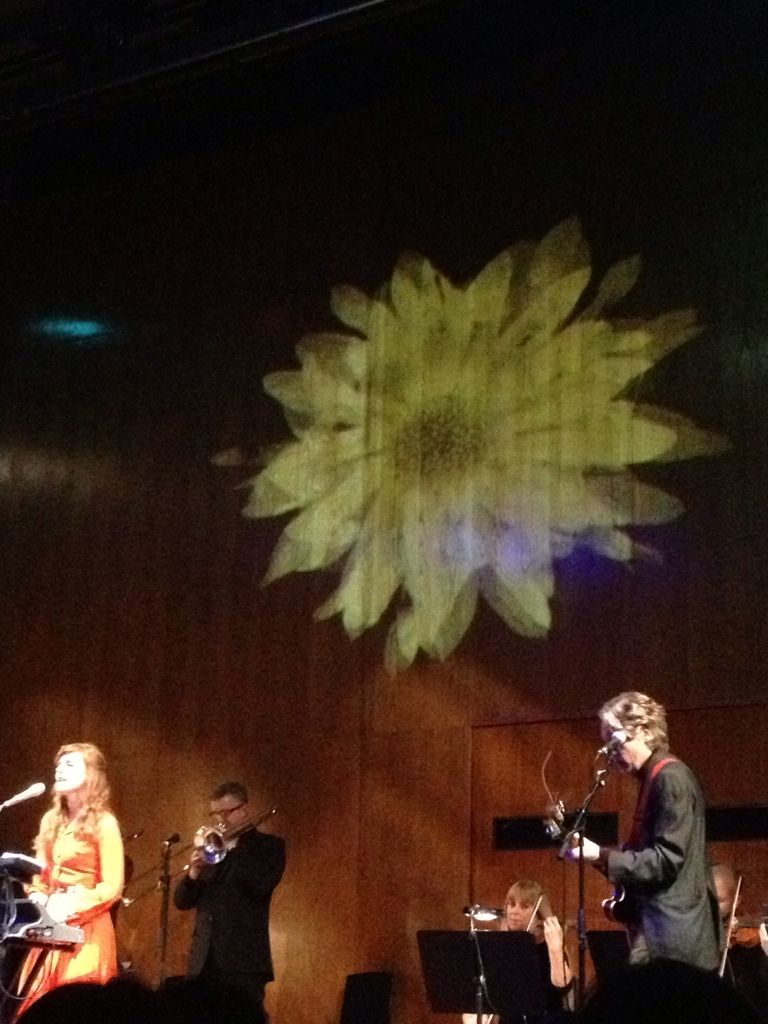
The gig was fab, the core three members were joined by strings, brass and drums on stage and they gave us an engaging, friendly, enthusiastic and brilliant performance. On the walk to Blackfriars Station, it rained, but I didn’t care, the South Bank was dark and beautiful, twinkling with the pale glow of Christmas lights strung in the trees and I was warmed by the magic of the Orkney Isles. I hope Betty Corrigall is pleased with the musical results of her visitation!

All photos © Mel Melis

Saturday, 13 October 2012

The Bog Man


When the moor succumbs

to bitter progress, they’ll dig

and find the bog man


stained by centuries

pulled from the glistening peat

like broken old roots


and rattle dumped for

an archaeological

examination,


his leathery hand

still clutch clawed over his keys,

a gold tooth glinting


in the hollow skull,

attached to slough skin fallen,

remnants of a beard


they’ll deduce he died

of cold and fear, the moor is

dangerous they’ll say,


it consumed him whole,

so satisfied they’ll drain it

and the ancient peat


will smoulder and yield

imprisoned in the concrete

silent in the mire

© Mel Melis 13/10/2012


I’ve not been entirely happy with my Haikus (on my other blog) of late. I went for a run and lo and behold, some inspiration. Running is thinking time. I wrote a poem about the mind cleansing solitude, the creativity to be garnered from a run, away from all that distracting technology which clogs our lives, how it touches something ancient, something physical, brings us closer to the animals were are.

Today I considered what it would be like if I were lost on the moor, sunk into the peat, only to be discovered hundreds of years into the future preserved like one of those bog men. What could they deduce about me? Would they work out I was more than just a stupid jogger who broke his ankle and sunk into the mire? Probably not and to be honest they wouldn’t need to, as they’d be right!

I’ve stuck this 8-haiku (5-7-5) piece on my main blog as it is more of a narrative poem. The abridged version is on my Haiku blog.

Wednesday, 10 October 2012

Storm Toad


Storm Toad

in the brief moment

of headlights catching

a snapshot of life,

brown-grey, born from clay,

the heavy stride of toad,

forelegs muscular, tense,

dragging,

pulling,

across the tarmac,

a river to cross, sheets of rain,

distant rumbles of death,

the spray of murderous tyres,

the searing light,

then unforgiving night,

resolute plod,

grim jaw dripping

with the residue of stormdrops,

mortar shells, boulders fall

all around

crash into mottled skin,

but though pained,

she’ll crawl on,

find the bed

for the long

winter sleep.

© Mel Melis 10/10/2012

Sunday, 7 October 2012

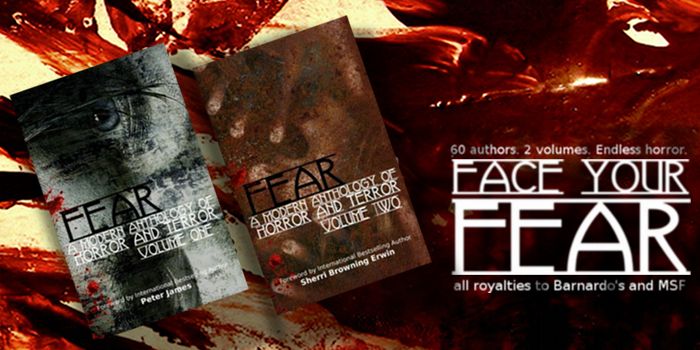
FEAR: A Modern Anthology Of Horror And Terror

So, one of my short stories has been published. Which is nice!

I speculatively submitted a short story for a great up and coming publisher Crooked Cat, they were looking to publish a short story anthology, bringing together many authors, to coincide with Halloween, with all proceeds going to charity. As you can guess from the title, the theme is horror/terror :)

(image from Crooked Cat)

So, to get the business side of things out of the way, if you want to buy it and support two great charities (Barnardo’s and Medicines sans Frontieres), then it’s available in both E-book and print versions from Crooked Cat’s own bookstore, or Amazon (UK links provided but also available around the world)

Volume 1 (print)

Volume 1 (ebook)

Volume 2 (print)

Volume 2 (ebook)

I also believe it will also be out on iTunes too.

---For info – I am in Vol2. End of Business Element of this blog post!

I was pleasantly enthused to see they considered my story good enough. It’s called Daisy and the Bear. The blurb for the book includes a reference to my story (see below). It’s about a girl and her teddy, her “loving toy”. I wont reveal any more, you’ll have to read it!

“Fear: A Modern Anthology of Horror and Terror brings together, for the first time, tales of murder, monsters and madness, by sixty of the world's best indie horror authors.
Discover what lurks in the water at the end of the garden, learn of the unforgiving loyalty of a loving toy and meet a writer, just itching to finish his latest horror story.
Every author in the Anthology has generously contributed their work for free. All royalties from sales will go directly to the international charities, Barnardo's and Medecins Sans Frontieres.
Fear, with forewords by international bestselling authors, Peter James and Sherri Browning Erwin, is released in two volumes in Paperback and on Kindle.”

This is the first time I’ve put my work out there, beyond a small circle of people.

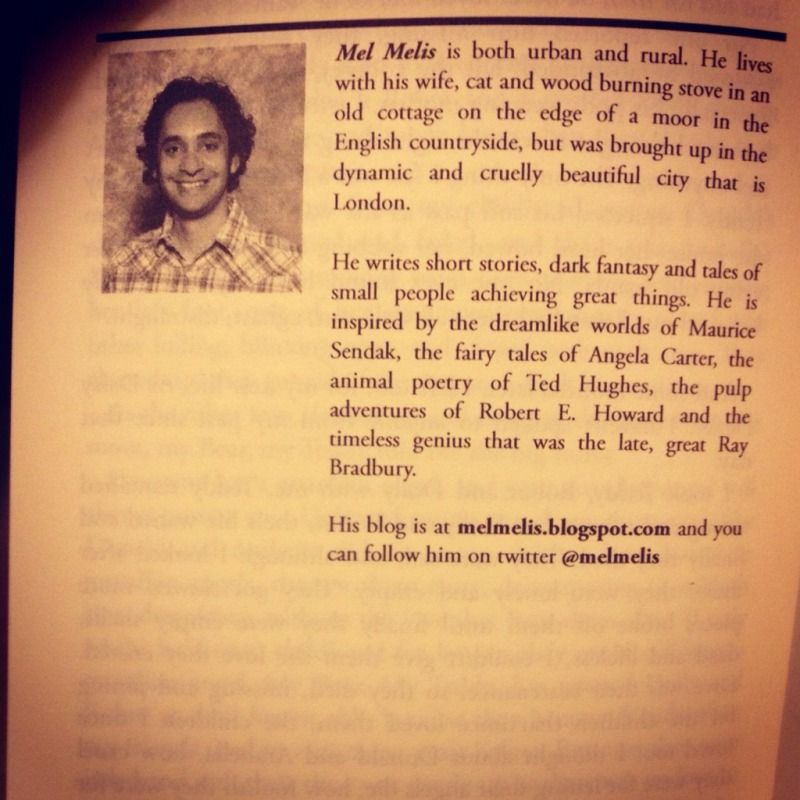
It tickles me to see this in print:

I like the photo, as it eliminates all the haggard worry lines and gives me a radiant youthful look. Almost cherubic. In real life I look like a brow beaten Cypriot mountain shepherd from the 19th Century lamenting the loss of his most powerful goat, so I’m grateful the camera is sometimes forgiving.

In summary:

Am I pleased? Of course.

Am I inspired to write more? Yes.

Am I nervous of negative scrutiny? Of course.

Am I entirely satisfied with the story? Not entirely! I’m still a baby when it comes to writing, I read it back to myself and doubt myself. Perhaps it’s slightly stilted, I don’t know. I wrote it a few years ago, I tidied it up and submitted. I like the story, I love the premise, but I think I have a problem with building suspense, the arc doesn’t feel organic enough. The only way to know is for lots of people to read it, I hope some will be kind enough to give me constructive feedback. But I wont be too hard on myself. I will strive to improve, get better and if I ever finish something novel length, then we will see. There is always room for improvement, there is always room to better oneself no matter how adept one is at their chosen craft. Perfection is elusive, perhaps out of reach, but we must always try our best.

Until then, I see this as a small but precious step in an adventure. I hope Crooked Cat make lots of money for the charities and I wish Crooked Cat and all my fellow authors, both new and established much happiness and success.

Thursday, 23 August 2012

When Art Restoration Goes Wrong

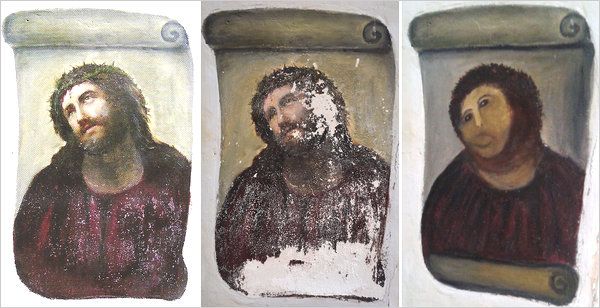
Poor Cecilia Gimenez, she’s been in the news recently after taking it upon herself to restore a much loved but deteriorating fresco “Ecce Homo” in her local church, the Sanctuary of Mercy near Zaragoza. It was painted over 100 years ago by the artist Elías Garcia Martínez.

The well meaning octogenarian mangled it to such an extent, the normally sedate BBC described it thus “the once dignified portrait now resembles a crayon sketch of a very hairy monkey in an ill fitting tunic". Ooooh miaow! But they do have a point.

Here are the three versions of it, the original, the deteriorated version and Mrs Gimenez’s magnificent restoration.

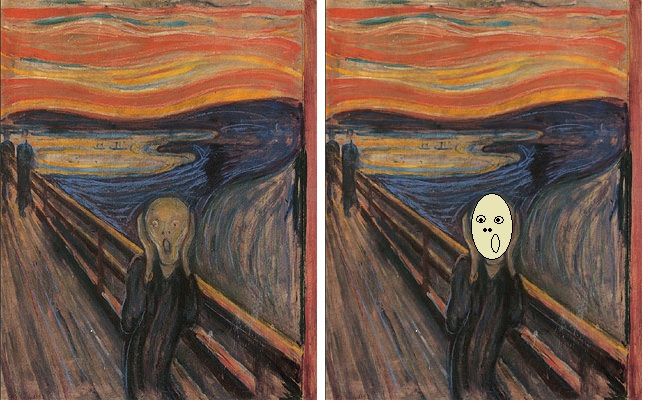
This got me thinking, what sort of a job would I do if I were to be given the opportunity to restore some world famous artworks? We’ll start with Edvard Munch’s “The Scream”. Let’s imagine I needed to restore the face, that anguished roar.

You know what. I’ve done a pretty fucking good job of it. I didn’t leave enough space for the mouth, so it’s kind of to the side, but I think this adds the vulnerability of the work, not only is the subject screaming, but they have a mouth on the side of their face, which probably led to much ridicule throughout their life and probably contributed to this outburst of deep seated pain.

Ok, let’s tackle Da Vinci’s Mona Lisa next. Yeah yeah yeah, that enigmatic half smile, the eyes that follow you round. I know he was a genius, I don’t deny him this. I’ve seen his shit man (you can read about it in this blog post which isn’t quite as silly). It’s great, not only was he a magnificent artist, but he was an inventor, an anatomist and a superb all round intellectual. I appreciate what I’m dealing with here. The leading light of the Renaissance, against an irreverent blogger whose intellectual peak came and went aged 6. 

Again, let us imagine her face needed restoration. Well, working from the original, I’ve come up with something close to Leonardo’s perfection.

Although some would say this looks like a really rubbish Homer Simpson sitting on the toilet, I think the constipated grimace does have an enigmatic quality worthy of Da Vinci. It would be several weeks before an expert in the Louvre noticed anything amiss.

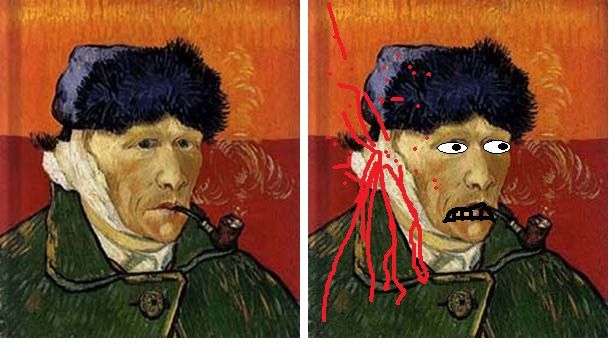
Ok, next artwork. How about Van Gogh’s Self-portrait with bandaged ear (and pipe) 1889? It’s an iconic image. So, rather than restore, I thought, what would happen if I improved the image? So here are the results. Note three important details. Melancholy eyes, blood squirting and a steely grit of teeth. For those not used to subtlety, you can show them this version and they will know EXACTLY what the artist was feeling when he painted this self-portrait. Otherwise, they may never appreciate the artwork and that would be a waste, they’ll just think he’s got the mumps or something and is a bit pissed off with the cold weather. So I think this new version is educational too.

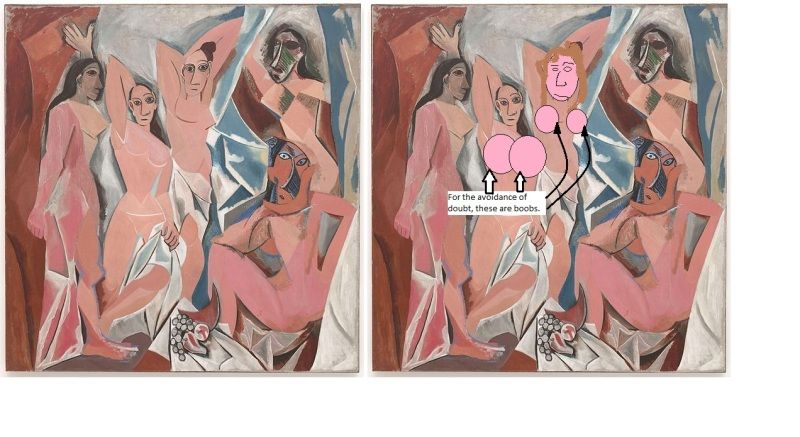
Right, onto my final piece. And possibly the most challenging. I have to say I worked and reworked this and I just couldn’t get the boobs right. It’s Picasso’s Les Demoiselles d’Avignon. The premise: What if some/a few of the boobs and a face needed restoring?

Well here is the result.

As you can see, I didn’t quite get this right, so I thought I’d add a descriptive guidance note to the work as well as some helpful arrows. I’m very happy with the nose though, it’s definitely Picasso-esque. In fact, it makes the original nose look fake.

So there you go, in summary, several reasons why I should never be allowed to touch any artwork anywhere in the world.

As for Cecilia Gimenez, I genuinely do feel really sorry for her. She acted in good faith and just messed up. So please take this blog post as just a bit of fun. No offence intended, I love all of these artists! And I love Cecilia Gimenez, because she tried to do the right thing.

Monday, 13 August 2012

Fighting Fantasy

1982

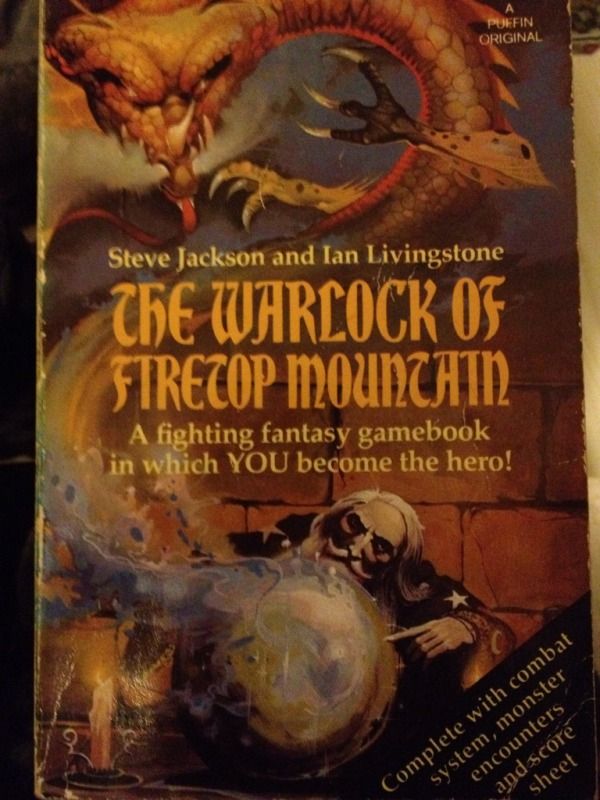
I distinctly remember being at school and one of my friends shoved a book in my hand, possibly Nick or Luke. I can’t remember who exactly, because the book was that exciting, their presence faded into insignificance and the only memory I have is of the endorphin hit of happiness as I feverishly got to grips with this new concept presented before me. It had a picture (cover art by Peter Jones) of a sultry smoking dragon on the front, writhing out from a unsettlingly stern faced wizard’s crystal ball.

My duffed up copy of Warlock

That book was The Warlock of Firetop Mountain, by Steve Jackson and Ian Livingstone. As the blurb on the front says “A fighting fantasy gamebook in which YOU become the hero!”. Unusually for any book, it was written in the second person, because the reader was directly influencing and interacting with the story path through a non-linear multi-choice system. Every choice made is then numbered, from choosing whether to try and sneak past a sleeping hobgoblin, or attacking him, going east or west, bashing a door down, or picking a lock. You flick backwards and forwards through the numbered sections of the story, depending on the options you choose. And there was also an element of randomness and fortune. So, two dice, a pencil and an eraser were essential equipment for any journey into the mysteries of the book.

You rolled dice to define the characteristics of your character before you set off. SKILL, STAMINA and LUCK were key to your characters survival. If your STAMINA ran out, through combat (also dictated by rules involving dice throws) or otherwise (e.g – a spiked pit you might stumble into), you were dead, you would have to start again. A high SKILL was important, as that made it more likely to defeat monsters or perform tasks. And a high LUCK was important, as there were times when luck was key to say noticing an important fact, or sneaking past a powerful enemy. You could pick up gold, provisions, keys, weapons and items, some of which might be useful, some might be useless. All of this information you scribbled on your character sheet.

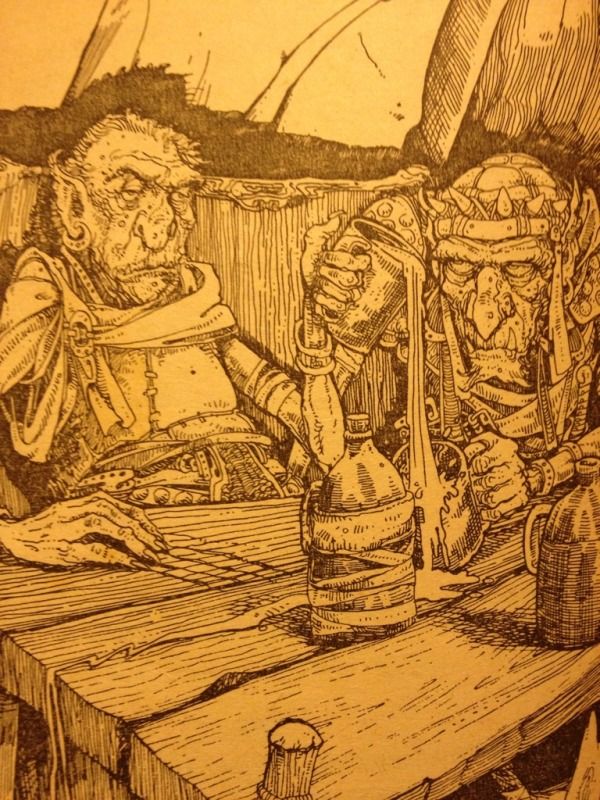
What complemented the book was also the illustration by Russ Nicholson. For example this illustration of two orc’s drinking grog. The incidental detail is astounding, the shading, the scoring of the table by the orc’s fingers, the vacant drunk expressions (looks a bit like some of the pubs I go to in north London). All the way through, the standard is incredible, bringing the story further to life.

Both Steve Jackson and Ian Livingstone have gone on and become fabulously successful in Role Playing, Tabletop Wargaming and Computer Game fields, but for a group of people of a certain age (35-45), we all fondly remember Fighting Fantasy.

After Warlock, many more books followed, my favourites I think were Forest of Doom, it had an eerie nightmare emptiness about it, punctuated by tough encounters with brutal monsters. And of course the classic Deathtrap Dungeon, which was really hard to complete, that claustrophobic feeling of being surrounded, unable to retreat and having little hope as various beasts or traps killed you in a variety of ingenious, frustratingly amusing or bloody ways. Baron Sukumvit was a right git.

2012

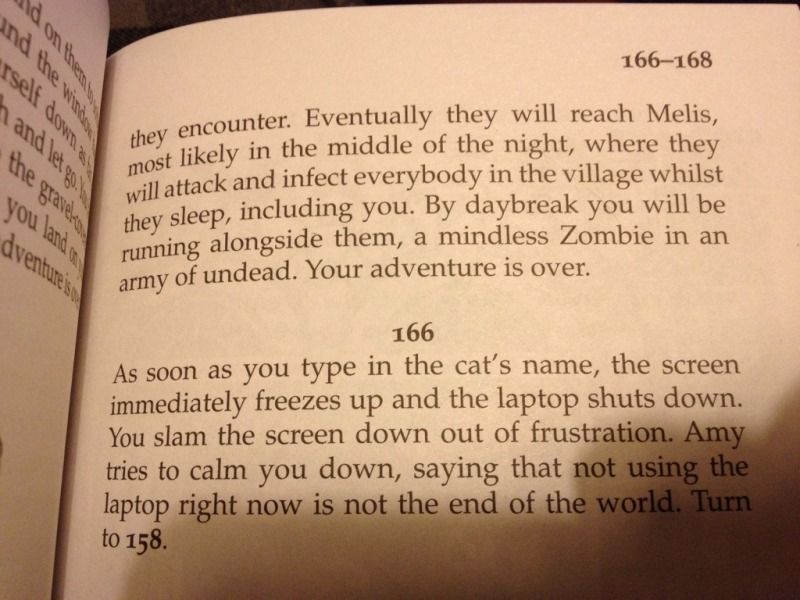
And thirty years later, a new book has been written by Livingstone, to commemorate this landmark. It’s set in a contemporary horror setting. Called “Blood of the Zombies” it puts you in the role of someone trying to prevent a zombie apocalypse. it’s gory, fast paced and fun. And the best bit for me is that I was one of a select few twitter followers who won an opportunity to have my name appear in it! (teeny spoiler below).

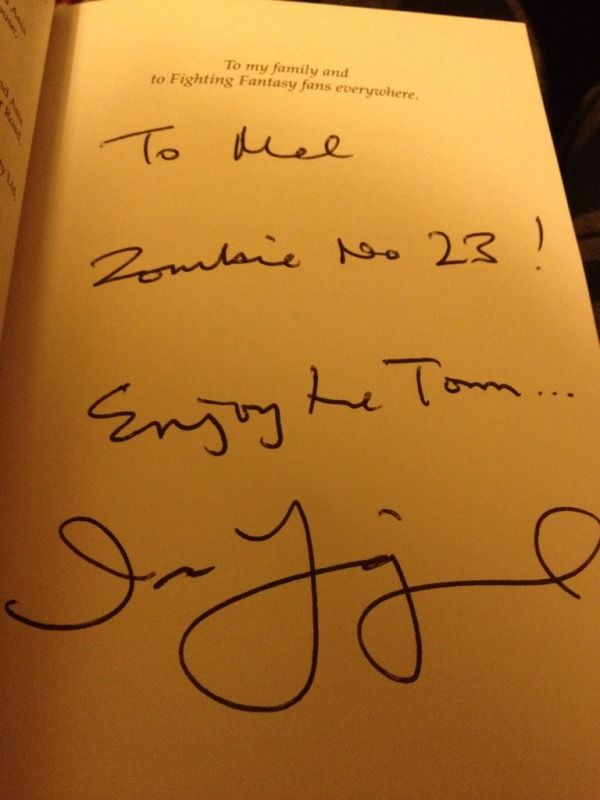
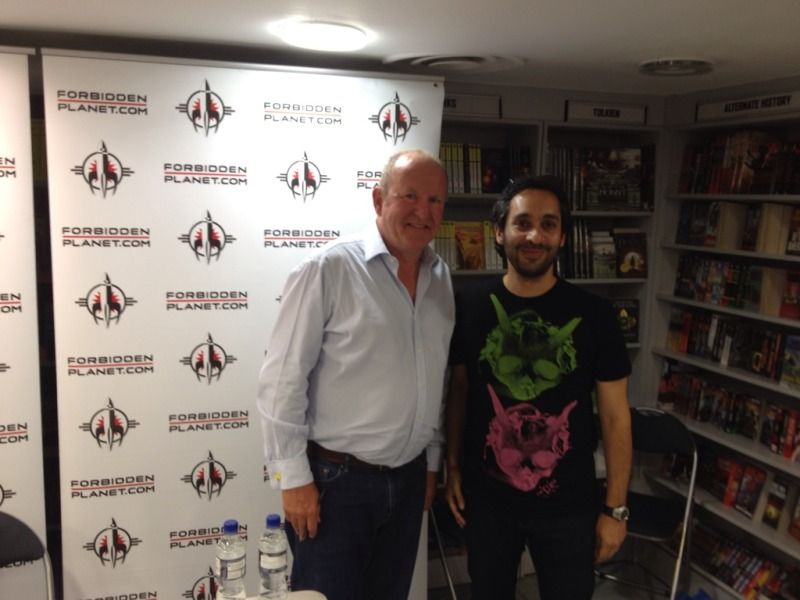
“Melis” is a village/town which appears in the book. Which I am massively excited about. I queued up at Forbidden planet to get it signed too. I’m Zombie no 23. “Enjoy the town…” writes Ian.

Below, two giants of computer science. Well, one giant and one dwarf.

As Ian has stated in recent interviews, Blood of the Zombies’ art nods to both the past but also today’s teenagers, it’s universal really. But I haven’t played it to any great depth yet as I want to keep my signed one pristine, I’m waiting for the iPhone app! (imminently coming out). No spoilers, other than the reference to “my” town in the photo above. Which neatly brings me onto computer games.

As has been oft reported, Fighting Fantasy were the book equivalent of an adventure computer game and the influence on modern computer games is not to be underestimated. So I’d like to thank Ian Livingstone, I guess without his intervention, the mystery of Computer Science may have been lost on me. Role Players also like computers and computer games. Not sure why, we just do, computers, geekiness and role playing are the holy trinity of awkward teenagers. So I studied computer science. Admittedly there were hardly any girls on my university course and I was pretty shit at programming, so at times I was just this bewildered socially incompetent nobhead with no girlfriend, but I’m happy I played the long game now :)  I’ve forged a decent career in IT Services and this allows me to make such bourgeois decisions as rebuying (I can’t find my original copy) a duffed up 1982 copy of Warlock for posterity and for that nostalgia hit. It arrived the other day. It still has the rubbed out scribbles of some contemporary of mine in the character sheet section.

It just wouldn’t have been right to buy a brand new copy. Therefore my collection spans a true 30 years now.

If you haven’t read any Fighting Fantasy books, try them. And remember. YOU are the hero. Blood of the Zombies (with my name in it hehe) – OUT NOW !

Sunday, 5 August 2012

The Olympic Torch Relay, the photography of Nick Turpin

I have to say, like many people, I’ve been slightly ambivalent to some aspects of the build up to the Olympics. But I should really caveat that opening statement!

1) The idea of a torch relay, bringing the sacred flame from Greece to the city hosting the games is of course an evocative one. And if we can take it to as many places in the UK as a build up to the opening ceremony, then this is of course fantastic. It makes it inclusive and will touch a lot more people than those lucky enough to have a ticket to an event.

2) I’m a big Olympics fan, always have been. The ideals of it, the concept of it being revived from that ancient games meeting, when a truce was called, suspending all wars to allow competitors to travel safely to Olympia, to compete for their city state. And in the modern era, the fact that athletes would trade all of their championships for one Olympic gold medal. It means so much to fans and athletes.

So my “issue”, although that’s probably too strong a word for it, was that the BBC were really milking the build up!

A secondary issue for me was that although there were plenty of worthy torch bearers, including local community heroes in each area, there also seemed to be a smattering of vacuous celeb’s muscling in, which was frankly, unnecessary and probably slightly bewildering to the locals who’d lined the streets to watch the torch being held aloft (For the avoidance of doubt Bruce Forsyth is awesome and not vacuous, but I’m disappointed he did his stint in Chelsea and not in Edmonton where he grew up!).

Which brings me onto the work of Nick Turpin. A few days ago an old school friend Cos approached me about checking out Nick’s work. Nick’s a street photographer who has been working with Nature Valley UK (one of the Olympic Sponsors) in taking photographs as the torch has made its way around Britain.

What I really love about Nick’s work is that he is interested in people. There is a warmth in his work, which goes beyond capturing the main event, i.e, the torch and torch bearers. 

There is something really nostalgic and comforting about photography of this nature, they are timeless pieces of work as well as being a valuable source of social history, which is sometimes overlooked.

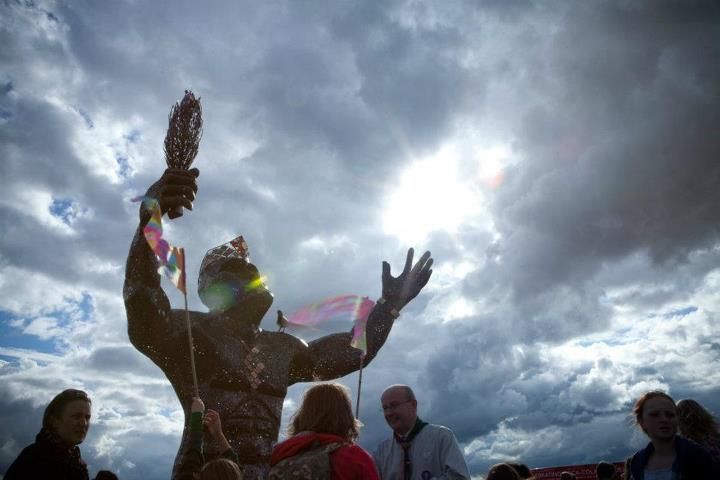
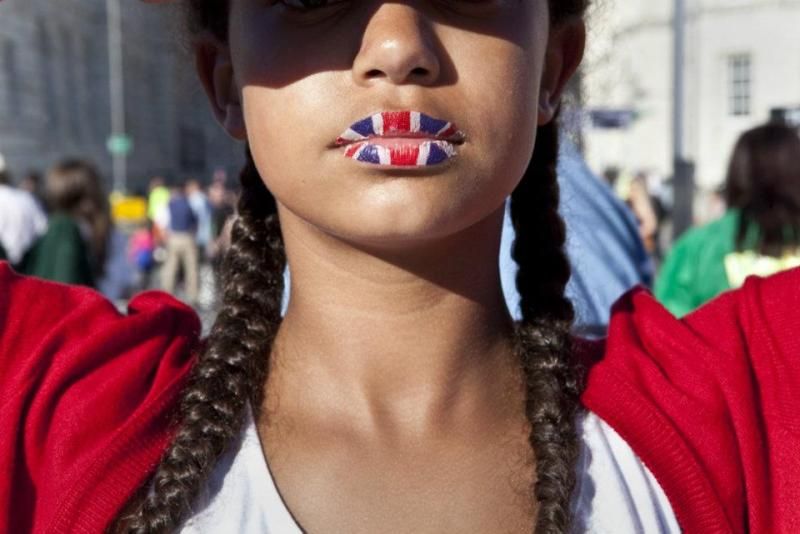
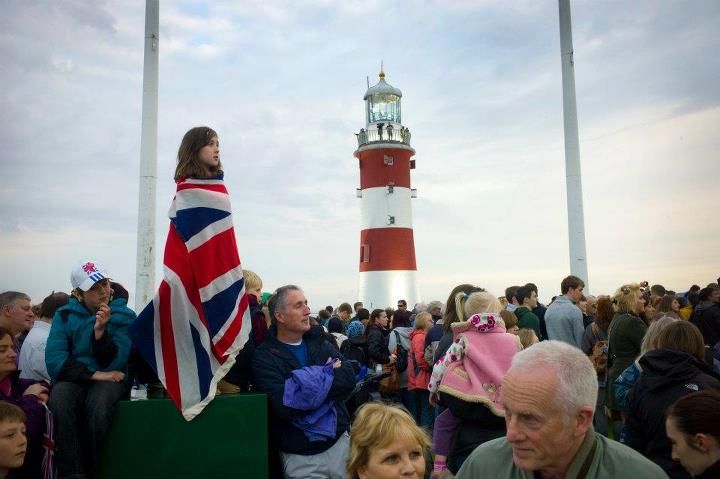
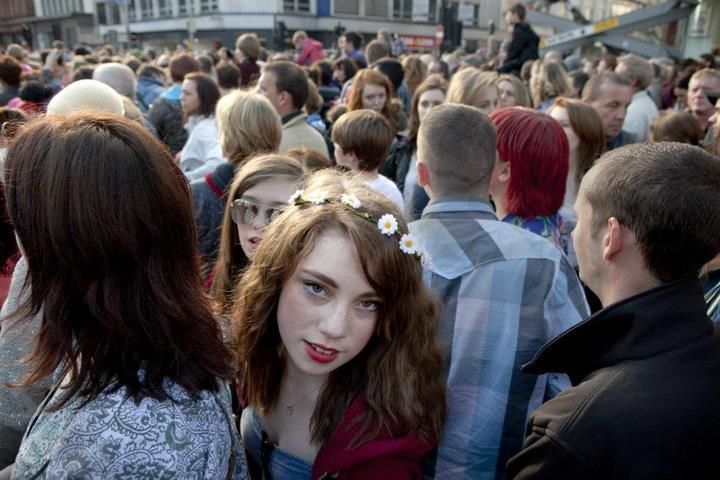
The toothy grins, the lined and wind eroded lived in faces of pensioners, the rosy cheeked glee of children playing, fancy dress, muddy ground. The social boundaries stripped down, where people of all backgrounds share the experience, straining their necks, having a picnic or waving their flags. It’s all there with the brooding skies of Britain, a threat of rain, wind swept hair and the occasional rainbow caught in the lens.

Co-incidentally, I went to Tate Britain yesterday, to visit the Another London exhibition of photography from 1930-1980. These works are well worth seeing, they hit the same sweet spots as Turpin’s work, one particular element made me smile. When Henri Cartier-Bresson visited London in 1937, on commission from a French magazine, to take photographs of the coronation of King George VI, he ignored the King and only took photographs of the crowd. The results were incredible!

I’ve really enjoyed checking out Nick’s work, which is all available on the facebook page here. But some of my favourites are below.

All photo credits to Nick and Nature Valley UK.

Salisbury

Liverpool

Plymouth

Belfast

Followers