Friday, 19 August 2011

British Masters

Last year I was fortunate enough to attend Lucian Freud’s last major exhibition at the Pompidou in Paris. There’s a blog about it in the depths of my timeline (here).
So it was with some sadness that I heard he died. He was our greatest living artist in my honest opinion.
The enthusiastic art historian Dr James Fox recently hosted a programme on the BBC called British Masters, he spoke with authority but not any pomposity about the period of British Art History 1910 – 1975. Assuming we don’t rip each other to shreds by then, he believes that in centuries to come, this will be seen as a defining period in Art, on a par with the renaissance, so his passionate delivery was a breath of fresh air.
Freud was old school, he knew, fraternised or fell out with most of his artistic peer group as well as his family. Sixty years ago he was getting drunk with Francis Bacon in some Soho dive. Within the last few years he was dancing with Kate Moss in some west London club. Even shortly before his death he was, on most nights, dining with one of his daughters in the Wolesley. As an aside the waiters laid his regular table in his honour with a black tablecloth and single candle when they heard he died – however some diners felt he had a scowl that could curdle milk should you annoy him. Next day, Dale Winton had his table, it is alleged…
Although intensely private, turning down interviews, writing shitty letters (which became so popular he stopped sending them as journalists would frame them) he led an active social life. On his own terms. It seems duty was not high on his agenda which meant he didn’t attend his mothers funeral, but that didn’t stop him being generous to those he loved. And it sounds like he loved a lot, with thirteen official children, and probably up to forty in total.
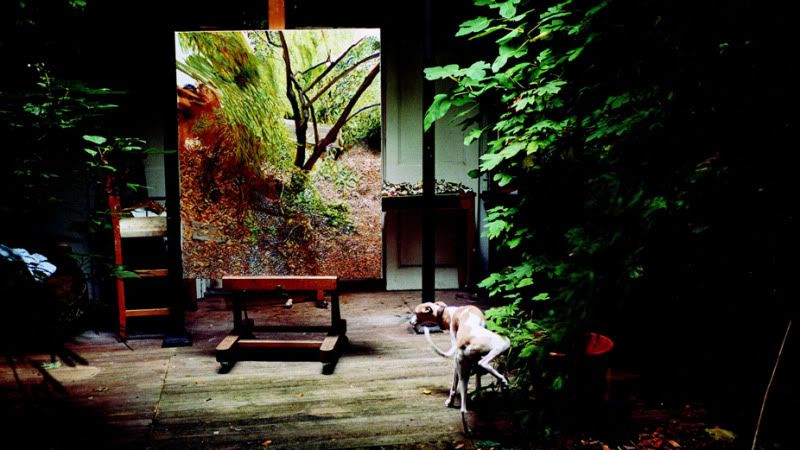
He worked almost to his dying day, a realist painter, his art recognisable from the flesh. He mostly painted from, and in, his studio. Apart from some very early works, he rarely painted an outside scene. Which is why this particular painting interested me. It’s from his garden, I can’t find the reference, so I may have imagined it, but I believe this is where he buried one of his dogs. It seems intensely sad to me. A pet’s love is unconditional, the tragic (and extremely simple) romantic in me thinks this some expression of love for a creature that has simple needs, he couldn’t handle or be bothered with the complexity of human relationships perhaps, breaking his habit of only painting indoors for old Fido or whatever his pooches name was. This is a photo of the work, by David Dawson his long time assistant.

It’s called “Painters Garden with Eli, 2006” – Eli being his last dog.
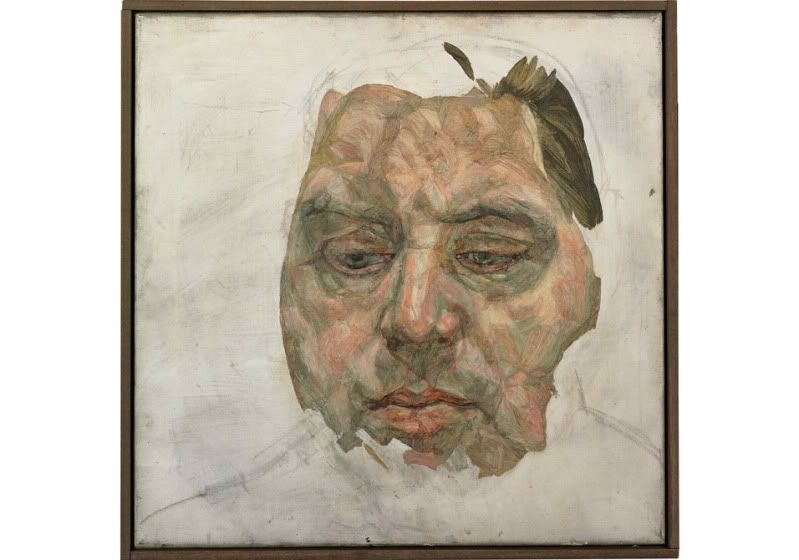
Tate Britain is currently exhibiting a few items from their Freud collection. This one particularly captivated me, it is of Harry Redknapp Francis Bacon, an unfinished piece. But getting right up close to it, you can see the incredible brushwork, Freud truly was a master.

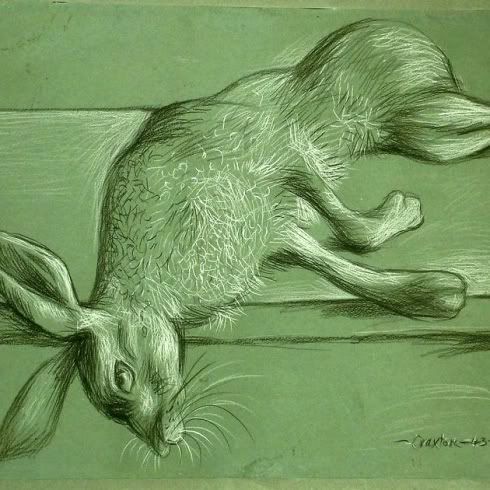
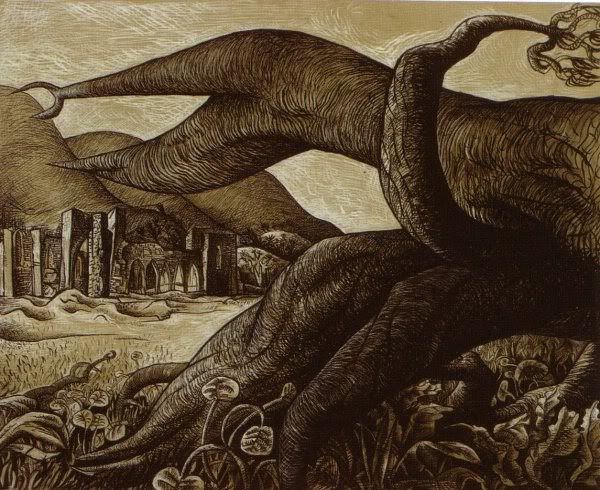
As well as this Freud work, there is a small gallery dedicated to an artist I’d never heard of before John Craxton who died in 2009. His early work was very fluid and technically brilliant, his later work being more free. “Neo Romantic” was the term the Tate used, citing William Blake as an influence.
I really liked his work, especially the early stuff. Such as :
Hare in Larder 1943

Llanthony Abbey 1942

Now Craxton, he roomed with Freud when they were studying. Craxton showed the greater promise as a youth, but Freud kicked on, whearas Craxton, although brilliant, lived the good life in Crete where he settled. Freud came to visit him and they would, as was the tradition in their friendship, exchange each others sketches and paintings at the end of the visit.
Now, Freud gambled, a lot. He generated huge debts. So much so that he sold Craxton’s painting to pay off some of these debts, with a “you don’t mind do you?” to Craxton, who was probably rightly slighted.
In later years, when the money wasn’t coming in for Craxton, he himself decided to sell a few Freud’s, they were worth a lot more money then, to raise some cash. After all, his old friend sold some of his paintings didn’t he?
The agent tasked with selling them, took the original works to Lucian Freud to verify their authenticity. Freud was not best pleased. But he verified them all right. On each, he wrote :
“John Craxton is a cunt. Lucian Freud”
RIP Lucian Freud and John Craxton.

Sunday, 14 August 2011

Japanese Post Rock

Been a while, but thought I’d post a catch up blog. Back in June I saw two Japanese post rock bands live. The first, Mono, I’ve liked for a while, so it was great to hear they were performing in London.
My favourite album of theirs, One Step More and You Die, has a great track called Com(?) on it. Sixteen minutes of heaven and hell, mostly hell. Must be played ear bleedingly loud.  Listen Here :)
So me and the Bossman went to Koko in Camden, interestingly, he hadn’t really got into their studio stuff so wasn’t sure what to expect, whearas for me I was expecting a torrent of white noise to lift the whole studio sound.
Bizarrely, I was disappointed and he was lifted. I wanted them to be louder, more engaging, more animated. I wanted more lank haired Japanese “Grudge” style hairstyles flying in a blur as they went mental on their instruments, but they were too busy playing tunes, no edgy improvisation, no spraying the crowd with silver paint, no instrument smashing. They were note perfect, cannot take that away from them, but they seemed too clean and clinical. Whearas for Rob, he switched on to their incredible depth of sound. It was probably me though as I had the hump from work.
Here is a short clip (as my photos turned out rubbish)
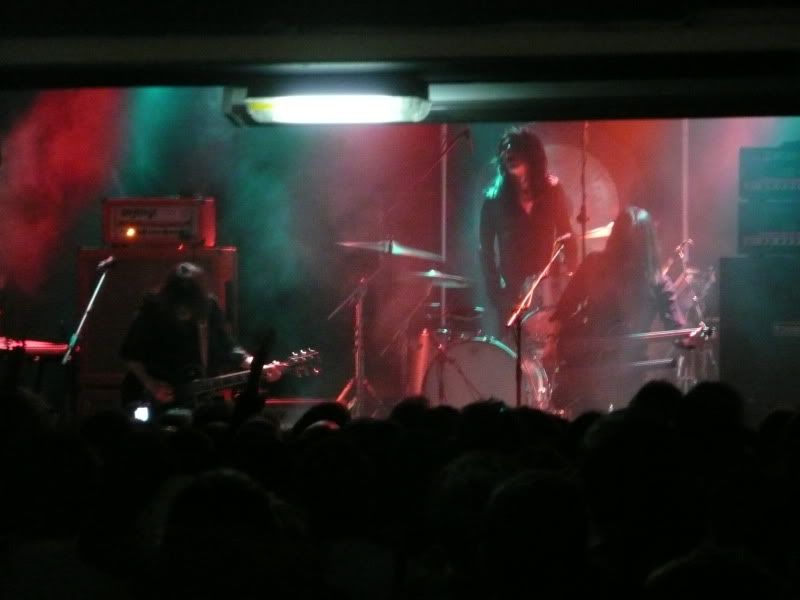
A few days later I saw Boris at ULU, as oft stated one of my favourite venues. The support act were Russian Circles who played at the Metal end of the Post Rock spectrum. They were mental. Loved them. Although my mate Sal felt they were guff, so he wandered back from the aural bombardment.
Here they are, you cannot see their heads because they didn’t have any.

Then onto Boris. Again, at the harder end of the post rock spectrum. They aren’t quiet-quiet-loud, they are more Loud-Loud-Loud-Quiet if I am to label them. They did deliver the animated crazy Japanese madness I so enjoy. Great band! In a small venue too. And the drummer had a gong, which is messed up.

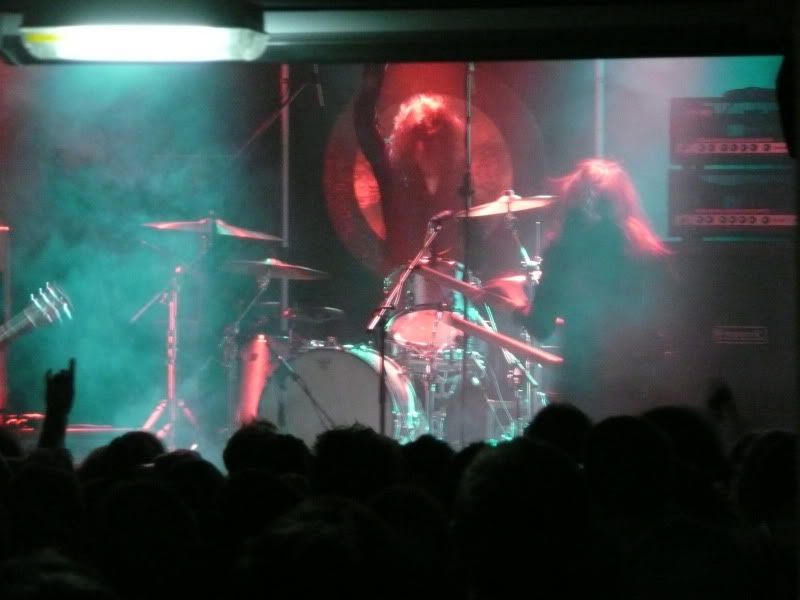
Loving this pic, they look like cast members of a particularly gruesome japanese horror movie. Especially the drummer who is floating in mid air (but more likely needing to stand up to fart)

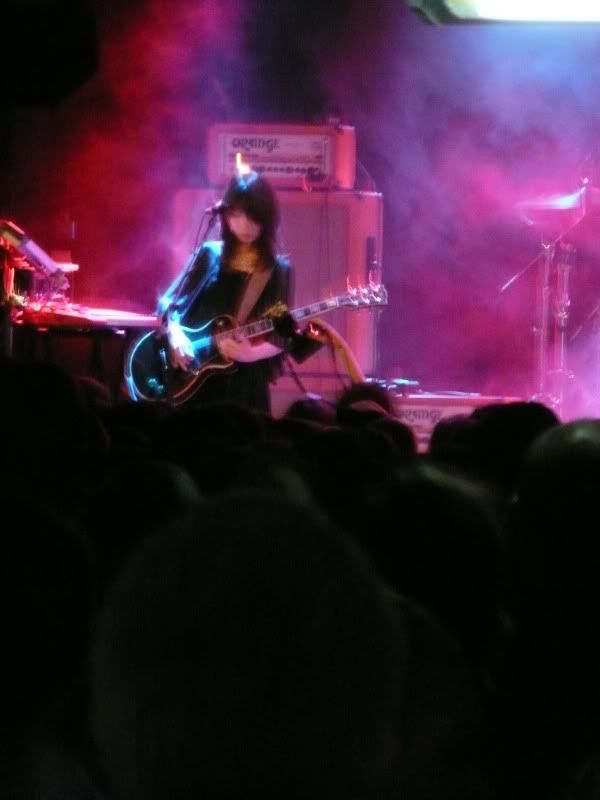
She was tiny, but could fret wank as well as any Japanese male guitarist.

Raaarrrrr smash the gong!

Tuesday, 7 June 2011

Ball and Chain

Went to the British Library tonight, a talk on Utopia under the banner of the Science Fiction exhibition “Out of this World”, quite interesting although very cerebral and philosophical. Is the concept of Utopia an elitist conceit, concieved under the pretence of tyranny or is the utopian ideal something we should collectively strive to, for our sustainable future? I don’t know the answers to these questions as everyone was cleverer than me. All I know is that I like Prawn Cocktail crisps. Quite a lot.
Iain M Banks was one of the panel members (I want his middle initial to stand for “Middle-initial” but sadly it doesn’t), a jovial, super witty writer who has spanned both mainstream and science fiction quite adeptly. The “M” initial only appears on his SF books by the way.
Was a good talk, was great to see Dave too.
But I’m writing this blog about something that happened before the talk and appealed to my pathetic sense of humour.
In the British Library foyer, is this chair. It is made of metal. It is heavy.
 
The ball and chain attached to it is also made of metal. And yes. It is heavy.
So when the random dad said to his young son “Look, a football!” and proceeded to hoof it, I cracked up when he crumpled to the floor and did that “I’m in agony, but I’m going to pretend I’m ok” walk out of the building. What a douche. He did move the ball though, it sort of wibbled a bit, unlike his foot which sort of splintered.
I always loved Tom and Jerry violence, should never have gone off air!

An Overheard Conversation

Last summer I attended a creative writing course. One particular task was to eavesdrop on other people's conversations and relay them in less than 500 words, I’m quite fond of the result. As most people are not the Dalai Lama, Muhammad Ali, Stephen Fry or Germaine Greer, most conversations are intrinsically boring, involving "what's for dinner tonight" - "dunno, soup?" etc. But I was lucky to catch the first line of a conversation when I visited the Saatchi Gallery last year. I plucked it, memorised it, scribbled it in my moleskine and the rest I embellished.

I'm fond of it as it is nothing like anything I usually write (someone usually dies or gets wanked off). I'm very fond of both characters and I feel I can't continue this story in case one or both of them die or get wanked off. So a 500 word limit was perfect! Enjoy

Mel

---------

“My legal name is Frances of course, but everyone calls me Fanny! It leads to much amusement with my bank manager!” the frail looking old lady announced with a snorting laugh.

She had one of those voices, which travelled, filled the room, clear as crystal, plummy, like an old school BBC radio presenter.

It belied her tiny body, with those sparrows’ ankles poking out the bottom of her long skirt, accentuating her patent leather red shoes.

She wore a blue fascinator, complete with veil. Her blue frilly blouse was buttoned up to her chin. She looked like an ice cream cone, with her head a precariously balanced scoop of vanilla, ready to slip to the floor and splat at the slightest touch.

Edward blinked and squinted through his jam jar glasses, struggling to focus. “Oh” he managed, before Fanny resumed her onslaught.

“I see from your name tag that you are Edward, jolly good. A proud, solid name.” she boomed whilst poking him on the name tag with her bony finger. He rocked back on his heels with each poke.

“And why are you here today Edward? Are you an artist too? Or an interested observer? Perhaps an art collector? You look the discerning type. Which part of the exhibition did you enjoy most? Any of my pieces catch your eye?”

Edward tugged the bottom of his jumper, straightening it out. He folded his arms, looked around and twiddled his thumbs as he struggled for an answer.

“Perhaps the depiction of Apollo?” she offered. “What of Thor? Anubis? Herakles?” She pounded him with the names of mythological gods, each one thumping him on the top of the head like a tent peg. Each time his knees buckled further into the ground.

“The last one” he muttered.

“Oh Herakles! Wonderful! Edward, you are so kind to say such things” she beamed, genuinely touched, fluttering her eyelashes from under the lace of her veil. Edward focused through his glasses and noticed the abundance of rouge on her cheeks, but also the sharp handsome bone structure, high cheekbones. She was probably a stunner in her youth, he mused.

Behind him, Edward heard a couple of youths sniggering.

“Look at that dog’s dinner going on and on”

“State of her!” replied the other voice with a guffaw.

Edward felt a pang of sadness for this eccentric relic of a bygone era. “Are you ok Edward?” enquired Fanny, gently touching his arm, her voice no longer booming but subdued and steeped in maternal care.

“Oh yes” he said. He unfolded his arms and offered one to Fanny. “Please show me, tell me more about your work. It’s beautiful” he smiled.

Fanny put her hand to her mouth with a tiny giggle, took his arm and leant on him for support. She blushed as they walked steadily back into the exhibition room.

Sunday, 29 May 2011

The Cult of Beauty, Victoria and Albert Museum

I should have written about this brilliant exhibition whilst it was fresh in the memory (I visited around a month ago), so my recollections will be slightly dulled.
I have to say, this period of British (art) history (1860-1900) fascinates me. As it’s the V&A, the exhibition covers more than art, looking at fashion, design, textiles, furniture making, sculpture, literature… So, the Aesthetic movement covered a far broader spectrum than my keen interest in the Pre-Raphaelite artists and I’m pleased to say I learnt quite a lot of new stuff.
This covers a period of time when the artistic elite all knew each other, literary giants rubbed shoulders with artists, musicians, actors and royalty. Would our current celebrities ripple through time like this bunch? Probably not! I doubt the V&A will host a “big brother/WAG/footballer” extravaganza in 150 years.
Scratch below the surface of supposed respectable Victorian society and layers and layers of decadence and self indulgence unfurled themselves. London however, was probably not a nice place to live back then. The Thames stank of human sewage, thousands of girls worked the streets, poverty and disease were rife, people doffed their caps and said “evenin’ mister, spare a farthing?”. And the “cure all” prescribed for most ailments was “Laudanum”, an opiate which got you soporifically smacked out your nut and by all accounts was very addictive too.
On entering the exhibition, a very small, understated portrait of Lizzie Siddal, painted by her husband Dante Gabriel Rossetti, a prominent member of the Pre-Raphaelite brotherhood. Red hair, back then, as now, was not seen as conventionally beautiful, but Rosetti captured it and her melancholy poise, wonderfully in this portrait. She is stunning (“stunner” was a word the Pre-Raphaelites allegedly invented for the young lassies that caught their eye).
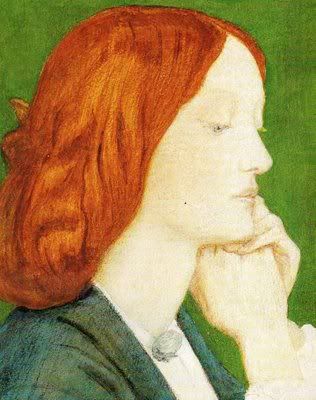
She was one of the super models of her day, most famous for being the model used by Millais for his Ophelia (a painting not included in this collection, but can be seen at the National Gallery). This painting is just achingly beautiful in my opinion. In a recent Millais touring exhibition, this painting was used as the publicity poster, apart from in Japan, where it was thought too dangerous, in case young girls would kill themselves at seeing such a tragic scene.
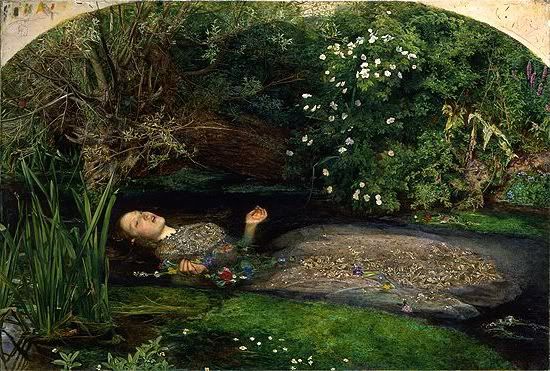
Detail

Following several affairs, including one with the wife of one of his loyal friends, the designer William Morris, Rossetti eventually married his long time, long suffering love. Her health was poor, from Laudanum abuse and at her death, the genuinely distraught Rossetti did write several poems for his dead wife and arranged for them to be buried with her. Upon realising he might make money from these poems, he had his wife exhumed… to retrieve them!
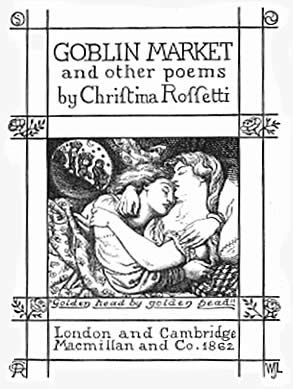
Which brings us onto Exhibit 2, Dante’s sister, Christina Rossetti. She wrote a long poem called “Goblin Market”, the first edition is exhibited here. Even reading it today, it conjures up quite vivid images of violence, sexual ambiguity and drug abuse. I’m surprised she got it published back then! Interestingly one of her main characters is called Lizzie, perhaps a nod in the direction of her future sister in law Siddal.
The story concerns two sisters and another girl as well as some abusive goblins trying to sell their addictive “fruits” to them. I wont go into much detail, suffice to say it’s quite disturbing at times, especially the violence. The sexual metaphors also range from the subtle to downright racy. When combined with the violence, it’s pretty hard hitting.
Unlike her brother, Christina never married or seemed to lead a life beyond writing, devotion to the church and charity. But her work… whoa! Extract from Goblin Market -
She cried "Laura," up the garden,
"Did you miss me ?
Come and kiss me.
Never mind my bruises,
Hug me, kiss me, suck my juices
Squeezed from goblin fruits for you,
Goblin pulp and goblin dew.
Eat me, drink me, love me;
Laura, make much of me:
For your sake I have braved the glen
And had to do with goblin merchant men
And the cover art of the book (by her brother Dante of course) is quite suggestive too.
And if we are talking of controversial poetry, then let us not forget Algernon Charles Swinburne (mentioned in my blog about Suffolk), the wild child poet, who is also represented in the exhibition. His poetry collection “Poems and Ballads” was attacked for its pagan sentiments, sado-masochistic themes and overtly sexual nature (including some in homage to Sappho of Lesbos). He was an atheist and a republican. Bit of a geezer really. Although, he may not have indulged in vice as much as his poetry built him up to. As Oscar Wilde said of him : “A braggart in matters of vice, who had done everything he could to convince his fellow citizens of his homosexuality and bestiality without being in the slightest degree a homosexual or a bestialiser.”
I’m missing out great chunks of the exhibition of course, but next on my list of interesting items is William Morris’ only known painting. It is of his wife Jane Burden (Morris).
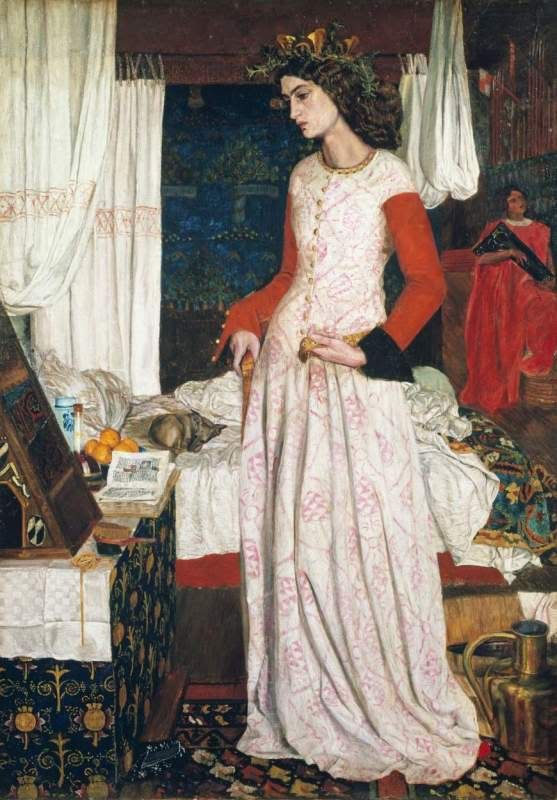
Morris was a designer by trade of course. His wallpaper designs are of course incredible (in the detail of the painting you can see some design elements too, on the dress, in the furnishings), so he didn’t feel up to trying his hand at art, but encouraged by Dante Rossetti he created this beautiful painting. Rossetti then had an affair with his wife after inviting her to model for him. Interestingly her wikipedia entry says their relationship was purely platonic. I wasn’t there of course, but I would like to say BOLLOCKS! They were at it. Fo’sure.
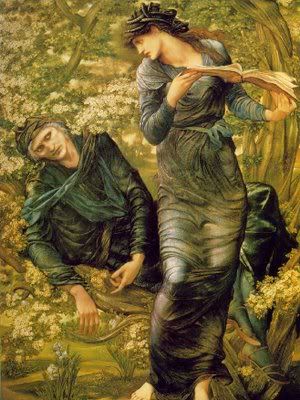
The next work of art is by Burne-Jones, another of the Pre-Raphaelite brotherhood. I have no anecdote to add for this one, other than the scale is huge and the detail incredible. It’s a lovely painting. Out of the big three original Pre-Raphaelites, Millais, Rosetti and Burne-Jones I would say the latter had the most consistently beautiful output. It is a painting of Merlin being beguiled.
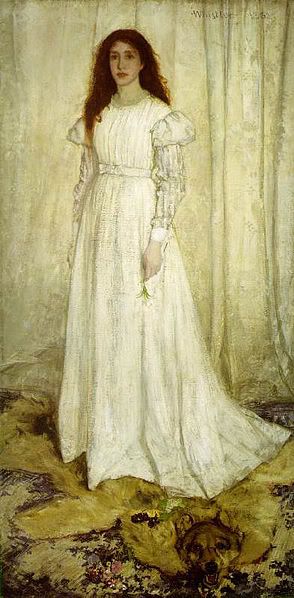
Next on the list, James Abbott McNeill Whistler. I wasn’t really aware of his work previously, so I was really pleased to see such depth of quality and style. He was a forerunner of the concept of the “installation”. He took great care to hang his own exhibitions, to make the most of space and environment. Artists prior to that just left it to the gallery to sort out, so he was ahead of his time.
Three very different works exhibited (amongst others) -
Symphony in White No 1: The White Girl
Some amazing detailed etchings of the Thames, incredible. Here’s one example.
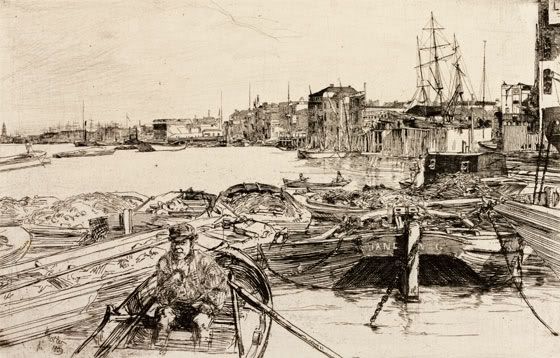
And another work from the Thames, which gives it an eerie foggy look.
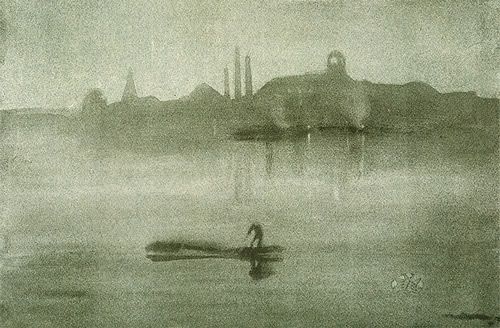
 
Whistler is cool, I’ve decided.
The shame was that John Ruskin, the eminent art critic, poet and social thinker, took offence to his work. In much more erudite terms he basically said Whistler was shit. How dare he try to copy Turner and include filthy cockney’s in his work was the nub of it. So Whistler sued him for libel. Now John Ruskin was a long time friend of Rossetti and was also Siddal’s patron. His wife had also left him… for Millais. They were all shagging each other, apart from Ruskin who had shagged no one. It seemed he was a lovely man, but unable to consummate his marriage. But enough about shagging, Whistler took him to court… and won. A farthing! (1/4 of a penny in modern terms). It was a symbolic victory as having to pay half the court costs bankrupted Whistler. He had to start again.
I mentioned Oscar Wilde earlier, something I’d never heard of before (but I’m going to buy a modern reprint with original art if at all possible) is his collection of children’s stories “The Happy Prince”, illustrated by Walter Crane. I’ve never tried to read Wilde before, I’m only 40 after all :)
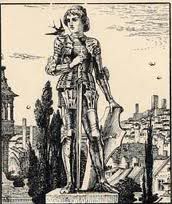
So I think I’ll start with this collection of stories, the first edition is tantalising open on the first page in the exhibition, made me want to punch through the glass and flick on to the next page!
High above the city, on a tall column, stood the statue of the Happy Prince. He was gilded all over with thin leaves of fine gold, for eyes he had two bright sapphires, and a large red ruby glowed on his sword-hilt.
He was very much admired indeed. ‘He is as beautiful as a weathercock,’ remarked one of the Town Councillors who wished to gain a reputation for having artistic tastes; ‘only not quite so useful,’ he added, fearing lest people should think him unpractical, which he really was not.
‘Why can’t you be like the Happy Prince?’ asked a sensible mother of her little boy who was crying for the moon. ‘The Happy Prince never dreams of crying for anything.’
‘I am glad there is some one in the world who is quite happy,’ muttered a disappointed man as he gazed at the wonderful statue.
‘He looks just like an angel,’ said the Charity Children as they came out of the cathedral in their bright scarlet cloaks, and their clean white pinafores.
‘How do you know?’ said the Mathematical Master, ‘you have never seen one.’
‘Ah! but we have, in our dreams,’ answered the children; and the Mathematical Master frowned and looked very severe, for he did not approve of children dreaming.
The Cult of Beauty is on at the V&A until 17th July. Check it!
Saturday, 28 May 2011

Obama does Ping Pong

I’m not going to comment on anything to do with the politics or the significance of Obama’s visit. Or the fact I still have faith that Obama will come through as one of the greatest Presidents. Or the fact Andrew Marr’s interview was just a sycophantic love in, asking him nothing of significance. This is the President of the United States, he’s agreed to an interview, ask him difficult questions, he’s not going to send you to Guantanamo you catfish faced bell end.
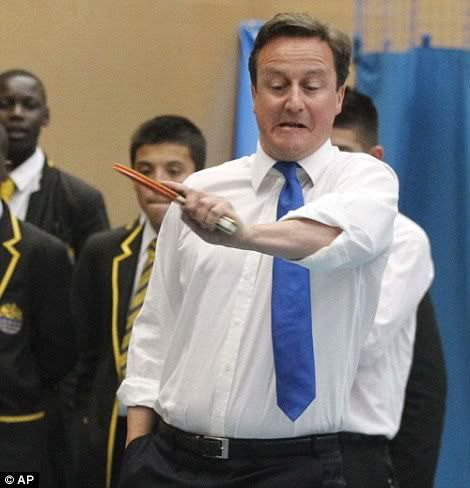
What I was really interested in, was David Cameron and Mr President playing Ping Pong.
Look at this pair. Obama is buff, determined, taut, yet supple as a Puma. And look at that bloated tweedle-dum behind him, flumping around like Christopher Biggins. I thought Eton boys did lots of sports. Well it looks like Cameron was a champion pie eater. The fat shit.


Friday, 27 May 2011

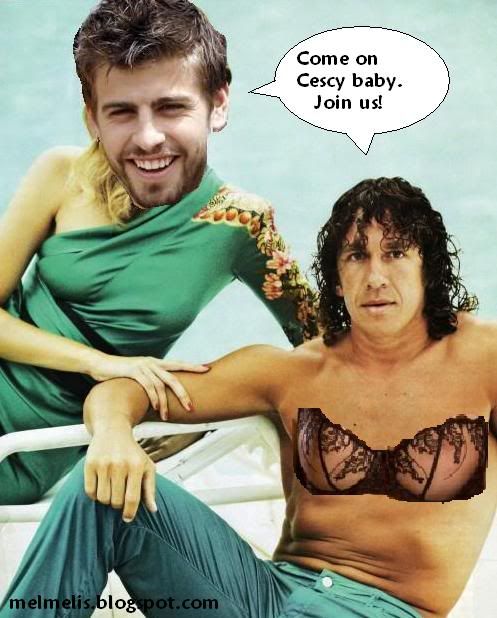
Cesc Allured by Barcelona Superstars Advances

Following this little escapade at Arsenal’s training ground, Barcelona stars Carles Puyol and Gerard Pique have gone to even greater lengths to try to attract Cesc Fabregas to Barcelona.

And yes, my MS Paint skills are rubbish

Followers